

Find the deal before it is a listing
Find off-market properties in public data layers. Qualify them against your buy box, then review a ranked queue with the evidence behind each match.
 1042 Ridgeline Ave
9.1
1042 Ridgeline Ave
9.1
| # | Parcel address | Title entity | Signal | Score | ||
|---|---|---|---|---|---|---|
| 1 | 4820 Turnpike BlvdMaricopa, AZ | Turnpike Flex Holdings LLC | 48,200 | 11 yr | Loan maturity | 91 |
| 2 | 1170 Vandalia RdTarrant, TX | Vandalia Industrial Partners | 31,500 | 18 yr | Absentee | 87 |
| 3 | 88 Copper Basin WayClark, NV | Copper Basin Yield LP | 62,000 | 9 yr | Long tenure | 84 |
| 4 | 2405 Frontage Rd EBexar, TX | unresolved | 24,900 | 14 yr | Tax delinquent | 78 |
| 5 | 615 Alameda CtPima, AZ | Alameda Court Assets LLC | 37,400 | 7 yr | Loan maturity | 74 |
| 6 | 9021 Rio Salado PkwyMaricopa, AZ | Rio Salado Storage Co | 55,100 | 22 yr | Long tenure | 71 |
| 7 | 340 Beltline Rd WDallas, TX | Beltline West Trust | 28,700 | 16 yr | Absentee | 69 |
| 8 | 1755 Cheyenne AveClark, NV | Cheyenne Flex LLC | 41,300 | 6 yr | Code violations | 66 |
| 9 | 77 Old Spanish TrailPima, AZ | unresolved | 19,800 | 12 yr | Tax delinquent | 63 |
| 10 | 6200 Ferguson DrTarrant, TX | Ferguson Yard Partners LP | 72,600 | 8 yr | Loan maturity | 61 |
| 11 | 412 Sunland Gin RdPinal, AZ | Sunland Gin Holdings | 33,900 | 19 yr | Deferred maint. | 58 |
| 12 | 2890 W Post RdClark, NV | Post Road Assets LLC | 26,400 | 5 yr | Absentee | 55 |
Parcel detail
914820 Turnpike Blvd
Maricopa, AZ · Turnpike Flex Holdings LLC
Overview
1998-built flex industrial, 48,200 SF on 3.9 acres. Held by Turnpike Flex Holdings LLC since 2015 at $4.12M, assessed today at $6.34M. County records show a CMBS loan maturing March 2026 with no refinance recorded, and an out-of-state owner mailing address. Long hold plus near-term maturity is a motivated-seller profile.
Property record
- APN
- 304-18-0042
- Asset type
- Flex industrial
- Building
- 48,200 SF
- Lot
- 3.9 acres
- Year built
- 1998
- Zoning
- I-1 light industrial
- Last sale
- 2015, $4.12M
- Assessed
- $6,340,000
Signals firing
- CMBS loan matures Mar 2026
- Held 11 years, no refinance recorded
- Owner mailing address out of state
Every parcel that cleared the criteria, ranked, with the record behind the one you open.
Illustrative platform view with synthetic property and owner records.
Watch AI off-market sourcing in action
0:40 · English narration and captions
Every parcel that cleared the criteria, ranked, with the record behind the one you open.
Illustrative workflow. Sample data, AI-generated visuals and voice; no client records.
How it works, I
Qualify against your criteria
Define asset type, geography, size, price and ownership signals with your team. The platform scores the available records and explains why each property matches.
Asset classes
Motivation signals
Your acquisition criteria become the qualification rules.
Illustrative buy box. The field set is our live intake.
How it works, II
Know what the sources cover
Assessor records, recorded deeds and business registries form the public data layers. We assess access and refresh cadence for each market, with licensed sources or visible gaps where needed.
Each square is one county, filled by how its records can be reached.
Illustrative footprint. The four access tiers are the classification every county is scored against.
How it works, III
Connect the asset to the right contact
Property records, entities and recorded roles form an evidence chain. Review why a person matches the asset, distinguish people with the same name, and see where a chain remains unresolved.
Parcel
1420 Sherman Ave
county assessor
Title entity
Prairie Hold Co LLC
assessor roll
Filing
Annual report, 2024
state registry
Person
R. Vance, manager
named on filing
Parcel
215 Oak Hollow Ln
county assessor
Title entity
Oak Hollow Holdings LLC
assessor roll
Filing
Agent of record only
state registry
Person
UNRESOLVED
marked, not guessed
Registry-only baseline across one six-state footprint: 35 to 50% resolved to a named person. Results vary by source and market; unresolved chains stay marked.
One chain that resolves, one that stops. Both are delivered.
Synthetic entities. The registry-only baseline shown was observed across one six-state footprint; results vary by source and market.
What makes it different
Built around how your firm buys
Start with sourcing on its own, or connect the qualified deal to outreach, underwriting, documents and closing.
Your buy box
Criteria and signals are configured with your team, including the factors specific to how your firm invests.
Evidence behind the contact
Review the public filings and recorded roles supporting a match before using it for outreach.
Visible coverage gaps
Unavailable sources and unresolved entities stay visible, with the last read and the point where the chain stops.
A connected next step
When outreach is in scope, email, messages and AI-assisted calls use your firm’s workflow. Replies and documents stay with the deal.
See it run on your own buy box.
Bring your criteria and one market. We show you the queue it produces and the records behind it.
The entry step
Start with the two weeks
$3,000 for two weeks of work you keep, credited in full toward your build.
- A worked target list across your buy box, scored on qualification signals.
- At least 30 resolved owner contacts, each with a direct line.
- The public-record chain behind every contact, and a written coverage read on the counties worked.
Apply the workflow
How does an off-market buy box become a research queue?
Start with criteria that a source can actually support. NextAutomation configures the sourcing workflow around your geography, asset criteria and review rules, then carries unresolved evidence into the queue instead of treating it as a match.
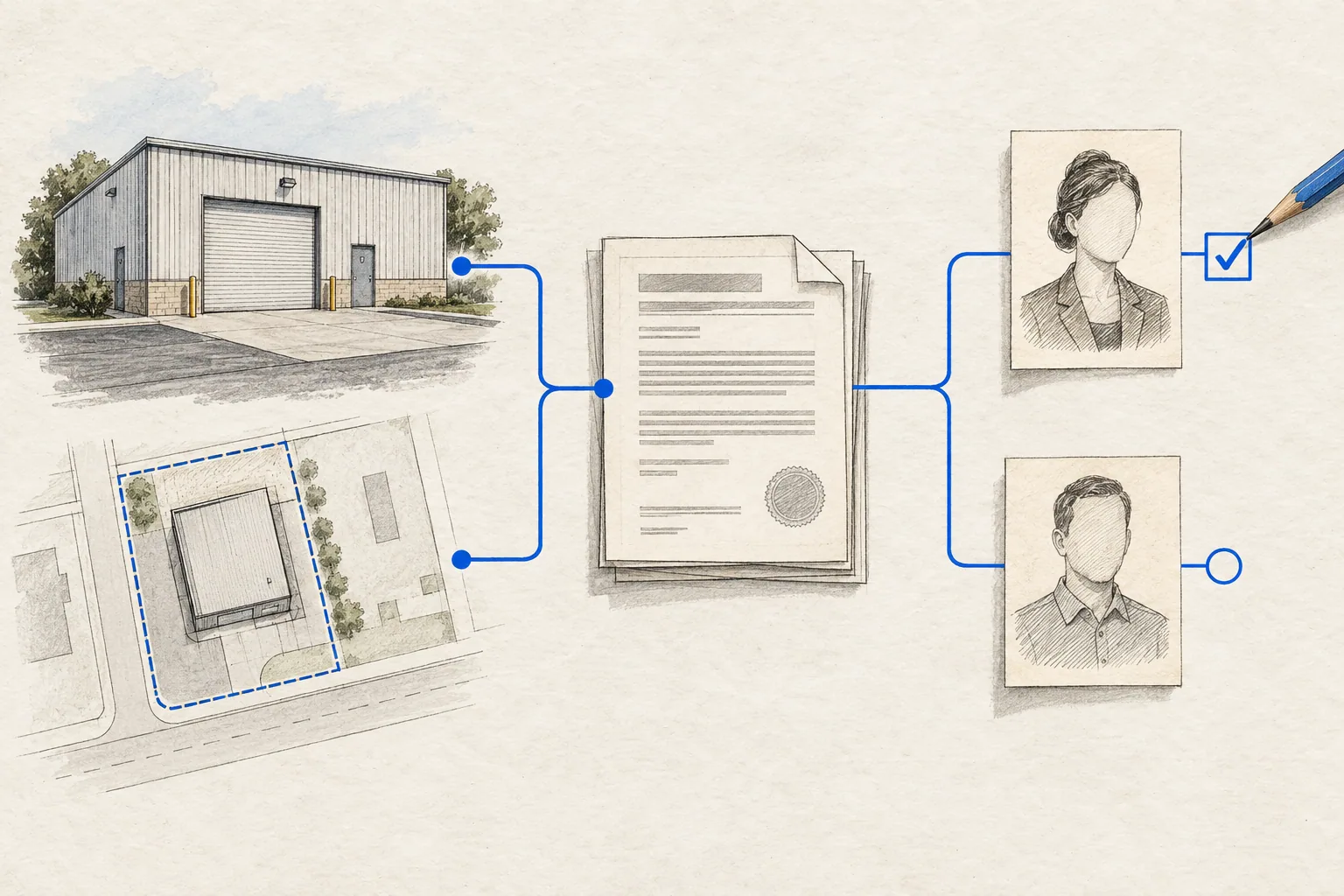
- 01Identify the property
- 02Resolve the holding entity
- 03Verify the person’s role
A property match, an entity match and a contact match are three separate checks.
| Buy-box decision | Record before searching | Check before outreach |
|---|---|---|
| Territory | State, counties and independent cities where relevant | Which jurisdictions have usable sources for this task? |
| Property fit | Asset definition, size range and exclusions | Does the source describe the same property or operating unit? |
| Ownership | Property entity, source record and observation date | Is the person an owner, officer, agent or an unverified candidate? |
| Next action | Why the candidate qualifies and what remains unknown | Has a reviewer accepted the match and the proposed next step? |
For a fictional 10,000 to 40,000-square-foot industrial buy box, a record with 25,000 square feet may pass the size check while outdoor-storage permission remains unknown. Keep the size observation and the open land-use question separately. Do not turn a missing field into a positive match.
Inspect the method before expanding the territory
The owner-portfolio worked example shows how confirmed holdings stay separate from candidate relationships.
Use the AI Acquisition Infrastructure pack to follow the handoff from research into screening and review.
To inspect property-level output for your mandate, request a sourcing sample before deciding whether separate owner-resolution work fits.