
Site selection evidence

Data-center site review: establish power and capacity evidence

A data-center opportunity should state whether it is land, a powered shell or an operating facility. Those are different evidence problems. Begin with the proposed IT requirement and the documented utility, cooling and connectivity dependencies. AI can organize commitments and milestones, but a nearby substation or a stated megawatt figure cannot establish a deliverable operating date.

NextAutomation editorial research method. Public sources establish the framework; the worksheet example is fictional and no property has been verified.

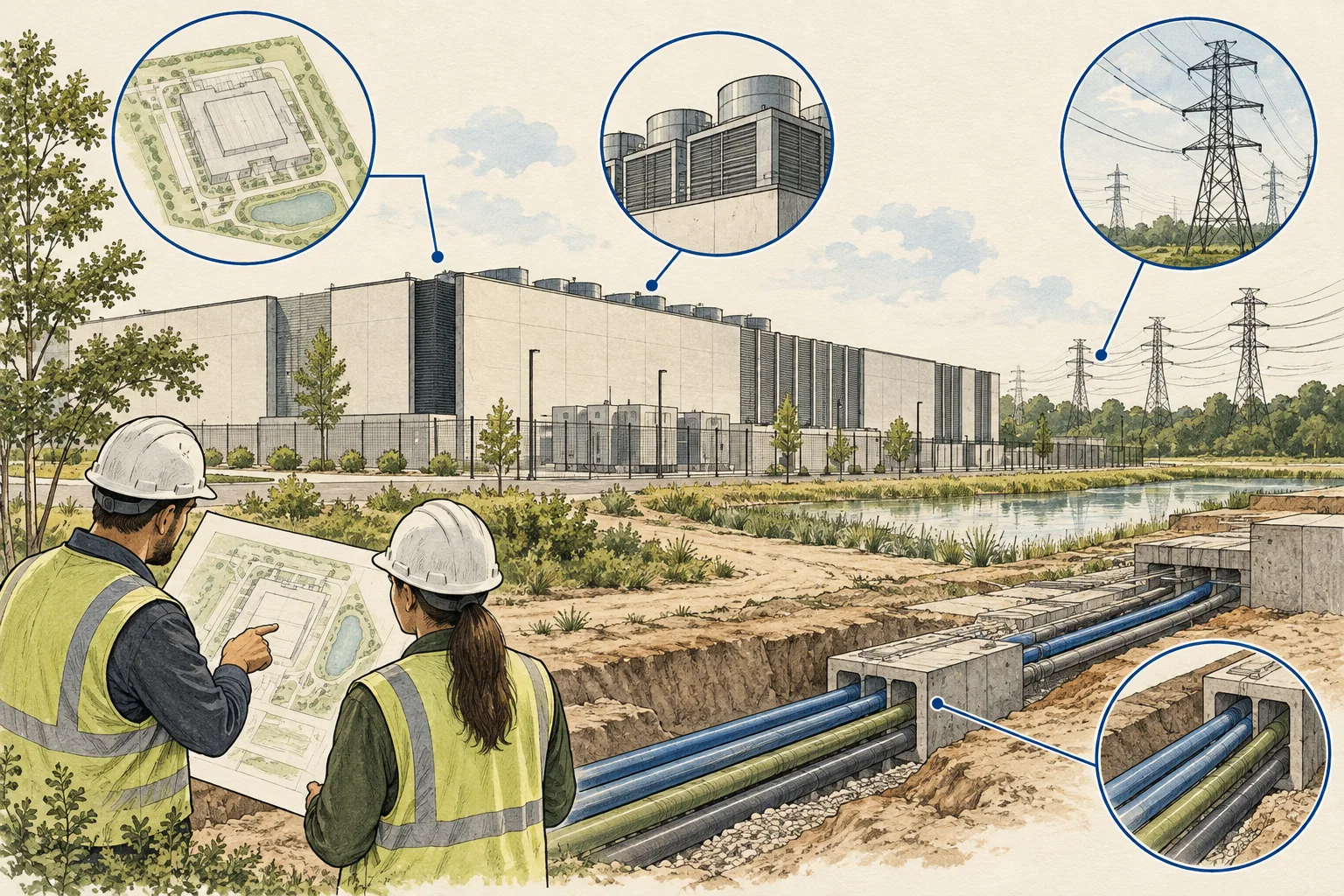
Conceptual illustration of data-center utility commitments, cooling dependencies and delivery stages

What changes the decision

Read the operating model before the headline

01

IT and facility loads are different

DOE’s data-center design guidance connects IT equipment, electrical systems, air management and cooling. Preserve those categories when reviewing a capacity claim. Ask what the quoted figure measures and which assumptions it includes. A building service rating should not be relabelled as usable IT load without a documented technical basis and review.

Source 1
02

Delivery stage determines the next document

Land requires a development and connection path. A shell requires evidence of installed and commissioned systems. An operating facility requires records of its actual configuration and obligations. Keep these stages separate in sourcing and underwriting so that a development prospect does not inherit operating-facility assumptions merely because both use the same industry label.

03

A date needs a dependency chain

A proposed service date may depend on utility work, permits, equipment, construction and testing. Record the party responsible for each milestone and the conditions attached to its commitment. AI can extract dates from supplied correspondence, but it should not convert an indicative schedule or a conditional letter into a guaranteed completion date.

Keep these separate

Three distinctions to preserve in the file

Evidence or situationWhat it tells youWhat to establish next
Site near infrastructureEstablishes geographic proximityObtain the actual service and development pathway; proximity is not reserved capacity.
Powered shell descriptionSuggests some building and electrical infrastructureConfirm installed scope, commissioning, remaining work and the capacity definition.
Operating facilityHas an existing technical and contractual configurationReview actual loads, service obligations and expansion limits rather than assuming spare capacity.

A worked review

Data-center capacity, contract and power basis

ClaimRetain beside itComparison rule
Fictional powered landUtility study or commitment, stated capacity, conditions and date.Requested capacity is not commissioned IT capacity.Source 1
Fictional powered shellInstalled electrical scope, remaining fit-out and commissioning evidence.Record what the buyer must still deliver before comparing with an operating facility.Source 1
Fictional operating facilityCommissioned capacity, phased customer commitments and billing start dates.Committed, commissioned and currently billing capacity need separate columns.Source 1
Development cost per MWPublisher, date, included construction scope and megawatt definition.A development cost is not a purchase price or appraisal.Source 1
Lease price and electricityBilled unit, capacity commitment, commencement and whether power is separate or included.The same headline rate can leave different costs with the landlord.Source 1
Power reconciliationUtility invoices, customer meter records and power charges for matching months.Unexplained differences go to engineering and accounting review; no efficiency ratio is presumed.Source 1
Conceptual illustration of data-center utility commitments, cooling dependencies and delivery stages

A practical review sequence

Build a file another reviewer can follow

Use the sequence below to turn the initial description into specific document requests. Preserve contradictory records instead of choosing the more favorable version.

  1. Define the intended requirement

    Ask the operator to specify the relevant IT load, availability objective, cooling approach and expansion sequence. Keep operator requirements separate from seller claims. This creates a meaningful basis for reviewing a site and prevents the team from comparing differently defined megawatt figures as if they were interchangeable.

  2. Build a commitments register

    Request utility agreements, connection studies or letters and their conditions, dates and counterparties. Label preliminary discussions, applications and binding commitments distinctly. Preserve any expiration or dependency stated in the document. The absence of a condition in a summary is not evidence that the underlying commitment is unconditional.

  3. Map systems and dependencies

    Collect design descriptions for electrical distribution, cooling, water where relevant and communications routes. Ask qualified reviewers to identify the interfaces and unresolved assumptions. Include shared infrastructure and third-party dependencies. The tool can organize references; it cannot validate redundancy, fiber diversity or commissioning results from marketing language.

  4. Prepare the delivery questions

    Turn each unresolved dependency into a request with a suggested owner: utility, developer, engineer, operator or counsel. Separate evidence of present capability from future expansion. Export the review sheet before moving to financial assumptions so the team can see which dates and capacities remain conditional.

Questions that arise during review

Resolve the ambiguity before the model

Does a power letter prove a data center is viable?

Read its exact scope, conditions and status. A letter may document a discussion or proposed service path without establishing a complete delivery commitment. The facility also needs a documented development, system and operating plan appropriate to the proposed use.

Can AI estimate available IT capacity from a building rating?

It should not do so without an explicit technical model and reviewed inputs. This kit preserves the capacity definition and requests the missing evidence. It does not calculate redundancy, efficiency, cooling capacity or a conversion from facility power to IT load.

What should an off-market screen retain?

Keep the site identity, development stage, source of each capacity claim and the unresolved delivery dependencies. These fields support a focused investigation. Avoid presenting unverified power availability or a future energization date as an established property characteristic.

How do you compare data-center price per MW?

First identify the interest being sold and what the megawatt measures. Then separate requested, committed, commissioned and billed capacity. Compare only like scopes, retaining utility and customer contract evidence.

Source 1
What should a data-center lease pricing review record?

Record the billed unit, contracted capacity, phased start dates, electricity treatment and shared cooling or service costs exactly as stated in the contract. Do not infer a power pass-through from the advertised rent.

Source 1

From the page to your next task

Start with the useful output.

Capacity-definition and delivery dependency register

Build an editable capacity-definition and delivery dependency register, retain document references and open decisions, then export your team's working file.

Scope: data-center utility commitments, cooling dependencies and delivery stages

Bring
An optional file nickname Status, observations and document references for the four evidence items; unknown is acceptable
Leave with
Capacity-definition and delivery dependency register with editable, expandable records and document locators Two fictional worked rows showing mismatches and decisions to review CSV and readable text exports with row provenance, method sources and edition A separate document-request companion with suggested reviewers

Edition 2026-09-30.1

Evidence and scope

Follow each claim to its source.

Commercial Real Estate Lending, Comptroller’s Handbook, version 2.0

Office of the Comptroller of the Currency · Checked 2026-09-30

March 2022 supervisory handbook; lease review, property income, re-leasing costs and property-type distinctions.

  • Bank supervisory guidance, not a property appraisal, current market survey or universal financing standard. No handbook percentage is adopted as a deal assumption.
Open original source ↗
Best Practices Guide for Energy-Efficient Data Center Design

U.S. Department of Energy · Checked 2026-09-30

July 2024 design guidance connecting IT loads, electrical systems, cooling and heat recovery.

  • Design guidance cannot verify utility delivery capacity, a connection date, redundancy or operating performance at a specific site.
Open original source ↗