


Land Use Restriction Agreement (LURA): How to Read One
Read a land use restriction agreement before underwriting affordable housing. Build a unit register of rent limits, source references and unresolved amendments.

Land Use Restriction Agreement (LURA): How to Read One
What is a land use restriction agreement?
A land use restriction agreement, often shortened to LURA, records restrictions on how a housing property may operate. Review the actual agreement for the covered units, income and rent requirements, duration and obligations that follow an ownership change. The label alone does not tell you which program or set of restrictions applies.
For federal housing tax credits, 26 U.S.C. § 42(h)(6) describes an extended low-income housing commitment recorded as a restrictive covenant binding successors. Section 42 distinguishes a 15-year compliance period from the extended use period. Do not treat the end of the first period as automatic permission to charge market rents.
Find the complete agreement stack
Request the recorded instrument and every amendment, the title commitment and referenced exceptions, the agency file, current compliance records and the rent roll. Use the recording number and legal description to check that the documents cover the property being purchased. A seller’s abstract is an index to the documents, not a substitute for them.
| Document | What to capture | Unresolved question |
|---|---|---|
| Recorded agreement | Recording number, covered property, program | Does it cover every parcel? |
| Amendments and waivers | Execution date, affected provision, reference | Is the amendment history complete? |
| Rent and income schedules | Issuing authority, effective date, unit basis | Which schedule applies to this period? |
| Utility allowance support | Method, date, unit category | Does the rent test include the right allowance? |
| Rent roll | Unit ID, designation, charge | Does the designation match the agreement? |
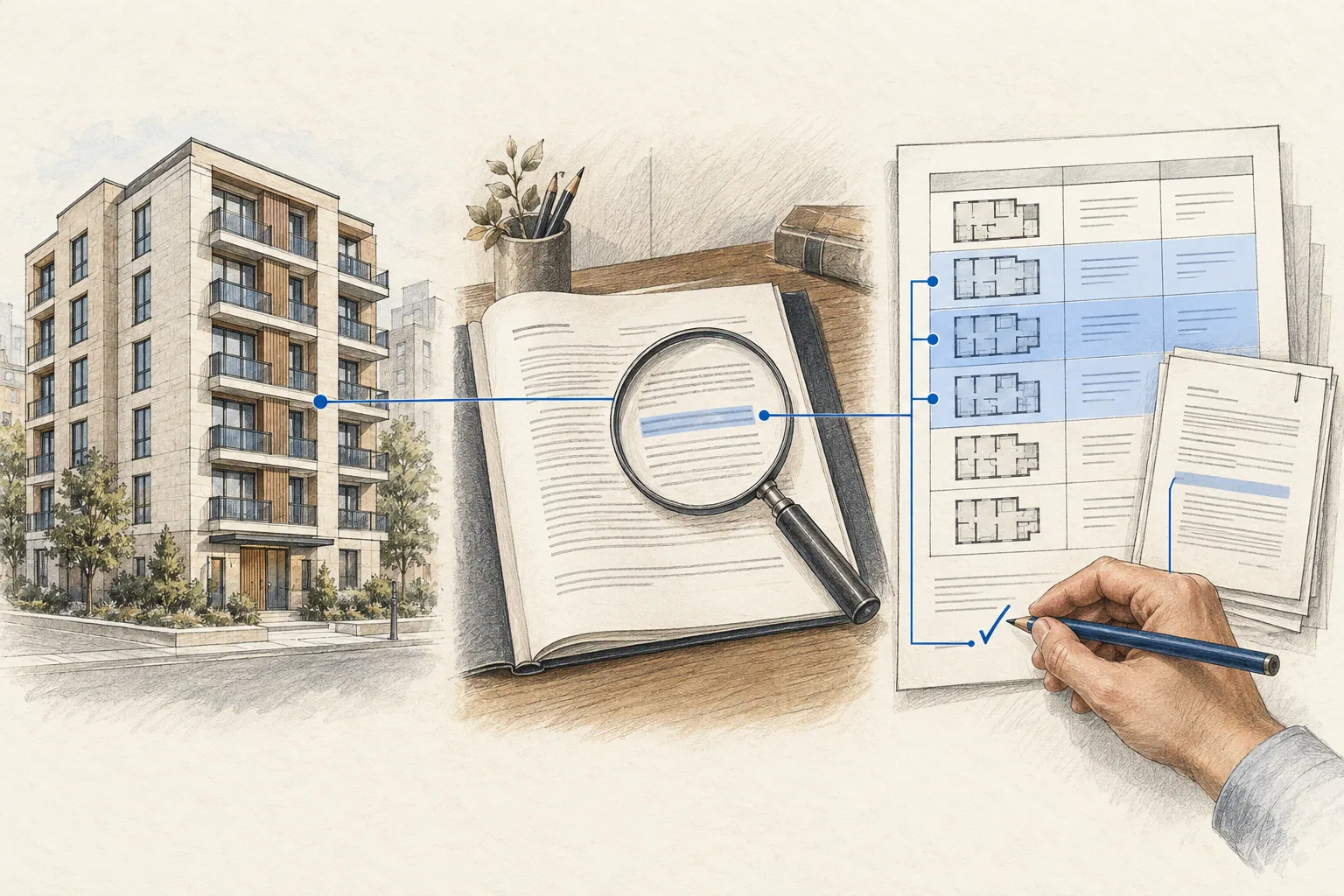
Build a unit restriction register
Keep one row per unit and one field per restriction source. Do not infer that a missing designation means unrestricted. The following six-row exercise is fictional; the references demonstrate the record structure and are not real instruments or published rent limits.
| Unit | Claimed designation | Source reference | Rent limit / allowance source | Review status |
|---|---|---|---|---|
| 101 | Program A, restricted | Agreement A § 3, p. 4 | Schedule A, current period / UA A | Matched |
| 102 | Program A, restricted | Agreement A § 3, p. 4 | Schedule A / UA A | Matched |
| 103 | Program B, restricted | Agreement B § 2, p. 2 | Schedule B / UA B | Check layered requirement |
| 104 | Unrestricted on rent roll | Agreement A lists unit 104 | Unresolved | Mismatch: request explanation |
| 105 | Amended designation | Amendment referenced, not supplied | Unresolved | Open: obtain amendment |
| 106 | Program A, restricted | Agreement A § 3, p. 4 | Schedule A / allowance absent | Open: obtain allowance |
The useful output is the exception list. Unit 104 needs a designation decision; unit 105 needs a document; unit 106 needs an allowance source. Assign a person and due date to each. Do not let all three become a generic “verified” checkbox.
How long does a LURA last?
Read the recorded term alongside the applicable program and any amendments. The federal tax-credit statute defines the extended use period by reference to the agency’s specified date or 15 years after the compliance period, whichever is later. It also addresses termination routes and tenant protections. Those provisions require transaction-specific legal review; an expiry date in a spreadsheet is not a release.
Record the claimed end date, the provision supporting it, any renewal or survival language, and who has accepted the interpretation. Before a rent-growth assumption enters the acquisition case, obtain counsel’s and the relevant agency’s confirmation of which obligations remain.
When more than one program applies
Build separate columns for each agreement. One document may define the rent restriction while another imposes an additional occupancy or approval condition. Ask the reviewer to resolve interactions rather than choosing the highest rent limit because it improves the model.
Keep historical rent, the accepted restricted case and any contingent future case apart. The affordable housing acquisition guide and restriction and rent-authority working kit provide the broader review sequence.
What AI should extract and what a person must decide
Use AI to assemble the register: quote or reference the clause, identify unit designations and report missing amendments. Ask it to show both sides of a conflict. Legal interpretation, program compliance and permission to change rents remain decisions for qualified reviewers.
A practical acceptance test is to select three units, trace each field back to its document and recompute the accepted rent test. If the source is missing, the status stays open. The commercial lease audit checklist applies the same document-stack discipline to ordinary lease files.
Build the review into your underwriting workflow
Our recommended implementation is NextAutomation’s underwriting workflow. It maps supplied deal documents into the workbook your team uses, with source references and an analyst review step. Agree the document types and exception rules during setup, then use the same checks on each acquisition.
See the investment committee memo workflow for how reviewed inputs connect to the decision document.
Frequently asked questions
What does LURA stand for?
LURA stands for land use restriction agreement. Read the instrument and program terms to determine what it restricts.
Does a LURA stay with the property after a sale?
Federal tax-credit extended-use commitments are recorded to bind successors. Have counsel check the particular instrument and transaction.
How long does a LURA last?
The agreement and governing program determine the term. The federal tax-credit compliance period and extended use period are different, so do not assume restrictions end after 15 years.
Can a LURA end early?
Do not assume so. Any proposed termination depends on the instrument, governing rules and transaction facts and needs specialist review.
Where do I find a LURA?
Start with recorded land records, the title commitment, the housing agency and the seller’s complete agreement and amendment file.
Related Articles
Claude for Excel for Real Estate Models: Trace and Check Formulas
Use Claude for Excel to trace a real estate model, test one changed assumption and independently reconcile NOI, debt service and DSCR with a worked cell map.
Hotel Property Improvement Plan (PIP): What It Is and How to Underwrite It
Learn what a hotel property improvement plan requires and model PIP scope, monthly cash needs and rooms out of service with a worked hotel acquisition example.
Ratio Utility Billing System (RUBS): How to Underwrite the Income
Learn what a ratio utility billing system is and test RUBS income against leases, utility invoices and cash collections before it enters your acquisition model.