


Hotel Property Improvement Plan (PIP): What It Is and How to Underwrite It
Learn what a hotel property improvement plan requires and model PIP scope, monthly cash needs and rooms out of service with a worked hotel acquisition example.

Hotel Property Improvement Plan (PIP): What It Is and How to Underwrite It
What is a hotel property improvement plan?
A hotel property improvement plan, or PIP, sets out improvements required to bring a property into line with brand standards. In an acquisition, start with the written scope and franchise documents, then model cost, cash timing and operational disruption separately.
Pebblebrook Hotel Trust’s 2025 Form 10-K explains that a franchisor or brand manager often requires a PIP after an acquisition. That does not mean every hotel sale triggers the same work. The property’s agreements and written requirements control.
Request the documents before estimating the budget
Ask for the brand-issued scope, issue and completion dates, approved modifications, drawings, contractor bids, existing reserve balances and the franchise agreement. Mark allowances and exclusions explicitly. A seller’s capital estimate may omit procurement, professional fees, disruption or work required by another agreement.
Record who approves a scope change and what happens if the deadline is missed. A verbal extension is an open item until the responsible reviewer has written confirmation.
Model a PIP as three dated schedules
| Schedule | Source | Model consequence |
|---|---|---|
| Scope and cost | Written PIP, accepted bids, contingency assumptions | Total capital requirement by work item |
| Cash by month | Procurement, deposits, draw rules, reserves | Peak cash requirement and funding gap |
| Rooms unavailable | Contractor phasing and reopening dates | Room nights exposed to disruption |
Link the schedules using a work-item ID. When a guest-room package moves by two months, its deposit date, room closure period and opening assumptions should move together. Keep the baseline and revised schedule so the committee can see why cash needs changed.
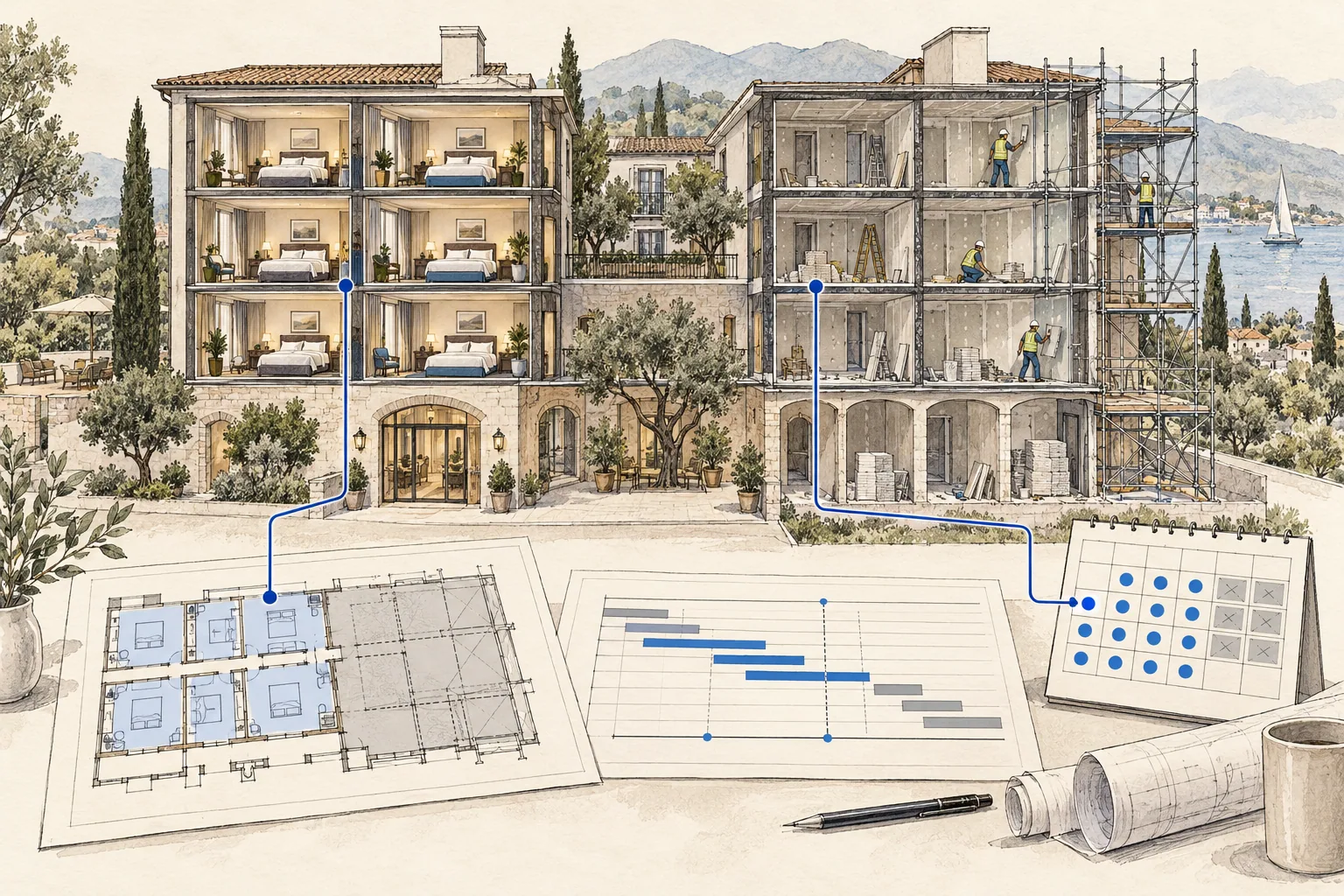
Worked example: a fictional 120-room hotel
Assume 30 rooms are unavailable for 120 days. That removes 3,600 available room nights. Applying a fictional 70% occupancy assumption and $150 average daily rate gives $378,000 of gross room revenue exposure: 30 × 120 × 0.70 × $150. It is a scenario calculation, not a forecast of lost profit.
| Scenario | Unavailable room nights | Assumed occupied nights affected | Gross revenue exposure |
|---|---|---|---|
| 120-day work period | 3,600 | 2,520 | $378,000 |
| Same duration shifted 60 days | 3,600 | Depends on seasonal demand | Recalculate month by month |
| Work extended by 60 days | 5,400 | 3,780 at constant 70% | $567,000 at constant $150 ADR |
A delay that shifts the schedule is different from an extension that keeps rooms closed longer. Do not add 60 days of disruption to a shift automatically. Replace the constant occupancy and ADR with month-specific assumptions before using the schedule on a real deal.
This gross exposure is not necessarily lost revenue: some guests may move into otherwise empty rooms. It is also not lost NOI: variable costs may fall, while contractor access, guest disruption and reopening costs can add expenses. Reconcile those effects separately.
Keep the PIP separate from the FF&E reserve
A reserve is a source or mechanism for funding capital; a PIP is a work requirement. Check whether reserve cash is available to the buyer and whether its use requires approval. Do not subtract a reserve balance from the purchase funding need until the closing and lender documents support access.
Track each item as priced, allowance, disputed or missing. The most useful next request may be a bid or a deadline confirmation rather than another percentage-of-revenue assumption.
Use a pending PIP as a sourcing question
An unfunded scope can justify asking an owner about timing and capital plans. It does not prove distress or willingness to sell. The off-market hotel sourcing guide shows how to turn property signals into a research queue.
Use the hospitality working kit for the decision register and the USALI statement comparison guide for the operating base.
Build the review into your underwriting workflow
Our recommended implementation is NextAutomation’s underwriting workflow. It maps supplied deal documents into the workbook your team uses, with source references and an analyst review step. Agree the document types and exception rules during setup, then use the same checks on each acquisition.
See the investment committee memo workflow for how reviewed inputs connect to the decision document.
Frequently asked questions
What does PIP mean in hotels?
It means property improvement plan, usually a documented set of work required to meet brand standards.
Is a PIP required when a hotel is sold?
It can be, but the transaction and brand requirements determine the scope. Obtain the written requirements instead of assuming every sale triggers the same plan.
Who pays for a hotel PIP?
Review the purchase agreement, franchise obligations and financing documents. Model who funds each item and when the cash is available.
How do I model revenue lost during renovation?
Start with unavailable room nights and dated occupancy and ADR assumptions, then account for recaptured demand and operating cost changes. Gross exposure is not the same as lost NOI.
Is a PIP the same as an FF&E reserve?
No. The PIP describes required work; the reserve is a funding mechanism whose availability and use must be checked.
Continue the workflow
For the next step, use hotel acquisition review.
Related Articles
Claude for Excel for Real Estate Models: Trace and Check Formulas
Use Claude for Excel to trace a real estate model, test one changed assumption and independently reconcile NOI, debt service and DSCR with a worked cell map.
Land Use Restriction Agreement (LURA): How to Read One
Read a land use restriction agreement before underwriting affordable housing. Build a unit register of rent limits, source references and unresolved amendments.
Ratio Utility Billing System (RUBS): How to Underwrite the Income
Learn what a ratio utility billing system is and test RUBS income against leases, utility invoices and cash collections before it enters your acquisition model.