

Indiana / Bay and building records

Indiana small industrial: verify the recorded bay configuration

An Indiana industrial assessment can locate a candidate building without telling you whether it functions as small-bay space. The acquisition question is how the structure divides into usable premises, with doors, services and circulation that support the intended tenants. Start with the property record, then require a bay schedule and current plans before underwriting multiple occupiers.

Indiana DLGF search and form resources checked September 30, 2026. No building was inspected or classified as verified small-bay stock.

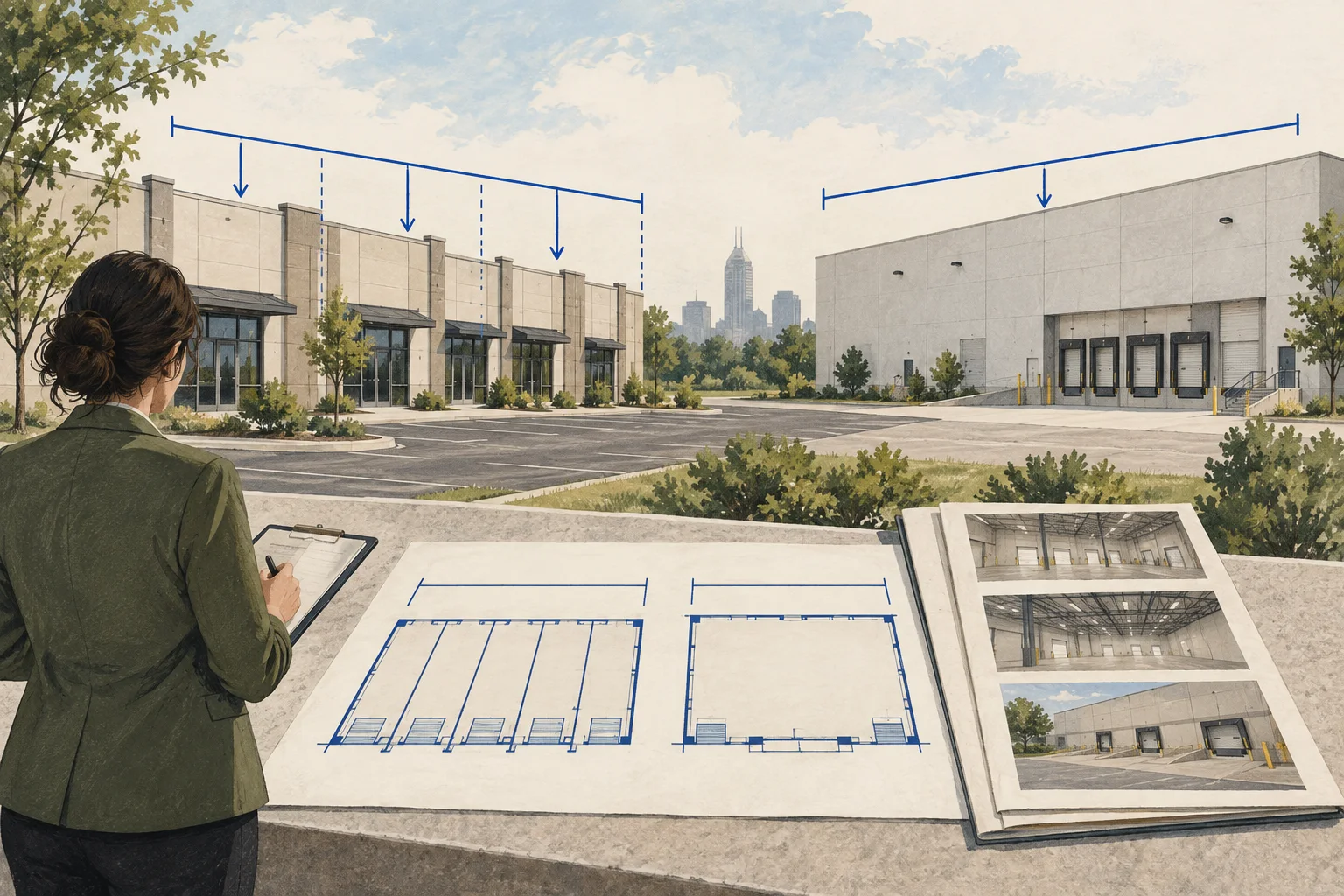
Conceptual evidence illustration for Indiana: small-bay configuration. No surveyed geography or real property depicted.

Start with the right evidence

What changes the decision

01

The assessment period matters

DLGF explains that assessed-value information comes from counties and distinguishes assessment and payment periods. Record the year with each value or description used. A recent download should not be treated as a new building inspection, and assessed value should not be relabelled as a buyer’s estimate of market value.

Source 1
02

The commercial record card is a starting structure

DLGF lists the Commercial and Industrial Property Record Card as State Form 50056. Request the actual local card rather than treating the blank form as property evidence. It can help organize the assessment questions while the seller’s plans and a site review address the current operating configuration.

Source 1
03

Multiple doors do not establish multiple leasable bays

Ask for a bay-by-bay schedule covering boundaries, access, services and occupancy. A doorway might serve a shared area or a single occupier. Keep observed physical features and the leasing plan separate so the proposed unit count does not get inferred from an aerial, exterior photograph or assessment category.

Different records, different questions

Keep these decisions separate

EvidenceUseful questionNext document
Assessed-value recordWhich tax period and assessed components are shown?County source record with the relevant year and description.Source 1
Commercial property cardHow does the assessment record describe the improvements?Actual local record card and clarification of outdated fields.Source 1
Bay scheduleWhat premises can the proposed tenants actually use?Measured demising plan, service schedule and occupancy evidence.
Conceptual Indiana research sequence, not a factual map or property inspection.

An acquisition desk workflow

Build a reviewable file

Use these steps as an editorial research method. The worksheet records what your documents support and assigns a next action to what remains unresolved.

  1. Describe the proposed tenant mix

    Write down the activities, access needs and service requirements the small-bay strategy assumes. Separate current tenancy from a future subdivision plan. This lets the engineer and property manager test specific premises rather than answer a vague question about whether the building is small-bay compatible.

  2. Obtain the local assessment evidence

    Use DLGF’s county-supplied search and the appropriate local record to locate the property and period. Request the actual commercial record card when needed. Preserve discrepancies with the brochure as questions; do not overwrite the source description with a new unit count simply because the marketing package uses one.

    Source 1Source 2
  3. Build the bay-by-bay plan

    Ask for measured boundaries, door positions, shared circulation and the service arrangement for each proposed space. Reconcile the plan with current leases or occupancy documents. Have qualified reviewers identify what physical or approval work would be needed for the intended configuration, rather than treating an unbuilt layout as existing inventory.

  4. Export configuration gaps

    The worksheet assigns record-period, demising-plan, service and lease-scope questions to named reviewer roles. Use it to identify which assumptions affect the acquisition budget or tenant plan. Download the evidence and requests before calculating per-bay economics so unsupported areas and proposed spaces remain visible in the discussion.

Before the next request

Questions worth resolving

Does an industrial assessment prove a property is small-bay?

No. It helps identify the assessment record, while small-bay usability depends on the actual premises and intended tenant requirements. Request plans and a bay schedule. Keep an existing multi-tenant configuration separate from a proposal to divide a single-occupier building into smaller spaces.

Source 1Source 2
Can door count become my rentable-unit count?

Not without a documented premises reconciliation. Doors can serve shared space, one large suite or non-rentable service areas. Ask the property manager and designer to explain each proposed bay’s boundary and access. Use a sourced schedule for underwriting rather than converting a visible feature into a unit claim.

How can AI help identify an Indiana small-bay configuration?

Ask AI to compare the dated DLGF or county record, the supplied commercial property card and the bay plan, retaining their different purposes. Have it flag proposed divisions presented as existing suites or doors without a premises assignment. The architect and engineer resolve physical configuration; the manager confirms lease scope and current occupancy.

Source 1Source 2

From the page to your next task

Start with the useful output.

Assessment-to-demising-plan register

Build an editable assessment-to-demising-plan register, retain document references and open decisions, then export your team's working file.

Scope: Indiana DLGF search and form resources checked September 30, 2026. No building was inspected or classified as verified small-bay stock.

Bring
Your case name Document status, observations and references for each evidence row
Leave with
Assessment-to-demising-plan register with editable, expandable records and document locators Two fictional worked rows showing mismatches and decisions to review CSV and readable text exports with row provenance, method sources and edition A separate document-request companion with suggested reviewers

Edition 2026-09-30.1

Evidence and scope

Follow each claim to its source.

Assessed Value Search

Indiana Department of Local Government Finance · Checked 2026-09-30

County-supplied assessed-value lookup, period and field guidance.

  • Assessment records do not measure current small-bay configuration or establish investment value.
Open original source ↗
DLGF Forms

Indiana Department of Local Government Finance · Checked 2026-09-30

Official forms directory including State Form 50056, Commercial and Industrial Property Record Card.

  • The form is a record structure, not evidence that a particular property has current measured details.
Open original source ↗