

Bay-level leasing evidence

Small-bay industrial: review each bay and shared service

Small-bay industrial research needs a bay-level record because tenants can share a building while using different doors, meters and outside areas. Start by linking each occupied bay to its lease, access and permitted activity. AI can assemble that crosswalk and expose inconsistent identifiers before a property-wide rent average obscures the cost of a particular tenant’s turnover.

NextAutomation editorial research method. Public sources establish the framework; the worksheet example is fictional and no property has been verified.

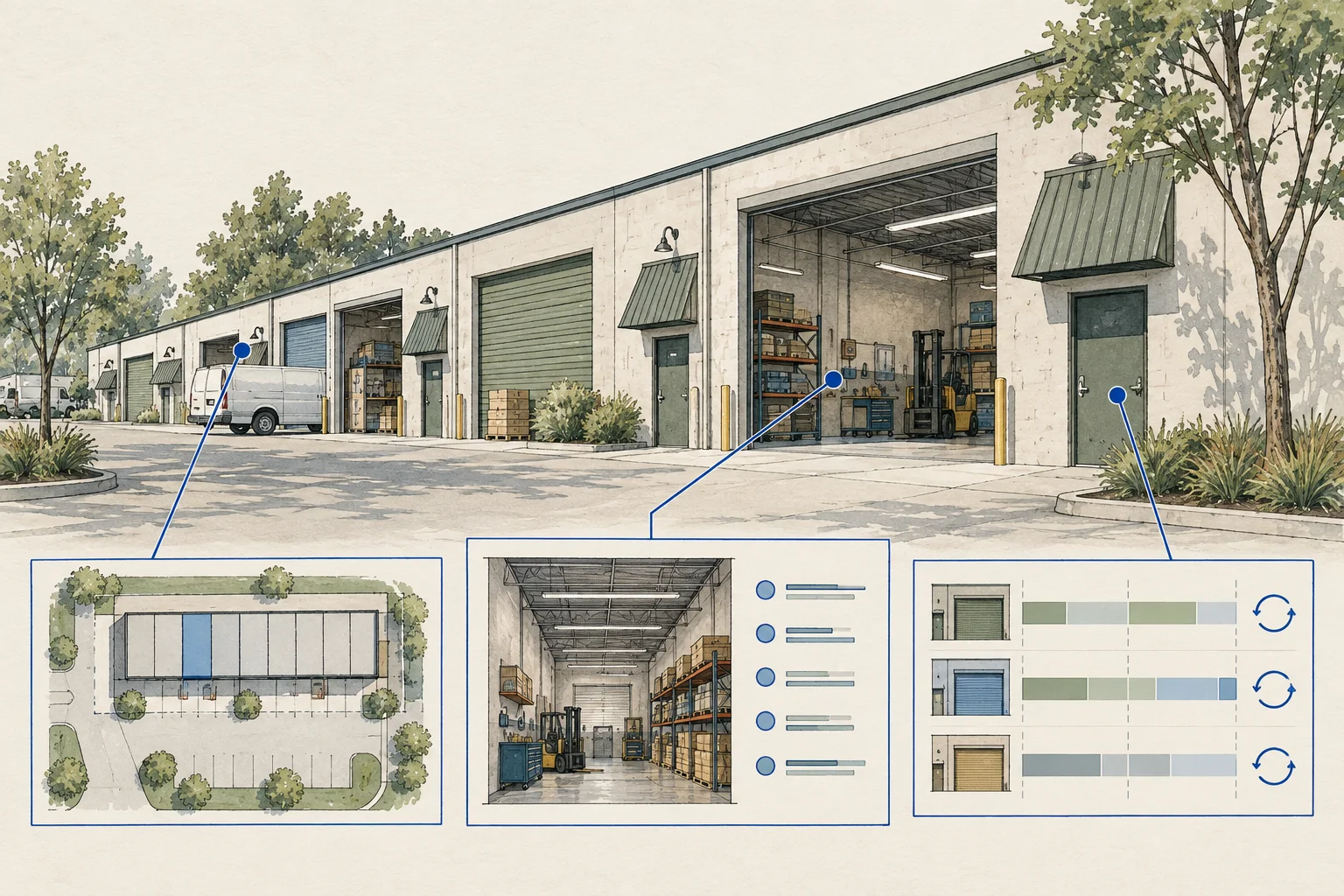
Conceptual illustration of small-bay leases, shared access and tenant-specific systems

What changes the decision

Read the operating model before the headline

01

The lease is smaller than the building

The OCC’s CRE handbook emphasizes reviewing lease terms and re-leasing costs. In a small-bay property, apply that discipline to each demised space. A building-level description cannot establish which tenant controls a door, loading apron or yard. Keep shared areas distinct from exclusive rights, and preserve amendments that changed the original premises.

Source 1
02

Tenant activities can vary sharply

Storage, fabrication, vehicle work and office use can place different demands on adjacent bays. Record the actual activities rather than assigning the building one generic use. Environmental, access and utility questions should follow those activities. The presence of an established tenant does not itself demonstrate that a proposed replacement activity has the same permissions or requirements.

03

Turnover can expose shared dependencies

A departing tenant may leave equipment, partitions or electrical arrangements that affect neighboring space. Ask which improvements belong to the tenant and what must be restored. Separate lease expiry from physical handover and reletting readiness. This creates a more useful research file than assuming each vacant bay can immediately be marketed at the same cost.

Keep these separate

Three distinctions to preserve in the file

Evidence or situationWhat it tells youWhat to establish next
Building floor areaDescribes the overall structureReconcile bay areas, common circulation and the actual lease boundaries.
Tenant rosterIdentifies reported occupiersMatch each tenant to executed premises, activity and renewal records.
Shared meter or drivewayIndicates an operational dependencyEstablish allocation, access rights and who must act when a tenant changes.
Conceptual illustration of small-bay leases, shared access and tenant-specific systems

A practical review sequence

Build a file another reviewer can follow

Use the sequence below to turn the initial description into specific document requests. Preserve contradictory records instead of choosing the more favorable version.

  1. Give every bay a stable ID

    Link the manager’s bay label, postal suite, lease exhibit and meter identifier. Flag spaces whose names changed after subdivision or combination. Keep a record of shared areas instead of allocating them arbitrarily to the nearest tenant. Ask for a measured plan when area totals do not reconcile.

  2. Abstract the occupancy obligations

    Record premises, term, options, permitted-use wording, access provisions and restoration requirements from the executed documents. Use AI to draft an abstract with page references, then review the entries against the originals. An unsigned proposal or expired lease should not silently become the current contract.

  3. Check the operational connections

    Request door dimensions, meter schedules and agreements governing yards or driveways. Identify activities that need a specialist’s environmental or permission review. Note whose evidence is missing, and distinguish a manager’s description from a measured or documented fact. Do not label a bay suitable simply because it has a roll-up door.

  4. Prepare a turnover handoff

    For the next expiring lease, list inspections, equipment removal, restoration, utility separation and documentation needed before reletting. Keep proposed rents outside the evidence baseline. The kit produces practical tasks and a review sheet, allowing the owner to assign follow-up without pretending that a desk review has priced the entire turnover.

Questions that arise during review

Resolve the ambiguity before the model

Is small bay just a size filter?

Size helps identify candidates, but the workflow depends on multiple small occupancies, shared infrastructure and bay-level turnover. Keep the building’s actual leasing pattern visible rather than relying on a universal square-foot threshold that may not fit the local market.

Can the existing tenant establish the next use?

No. Its activity is useful context, but the next occupier may need different approvals, systems or access. Request a description of the proposed operation and have the relevant reviewer assess its requirements against the documented premises.

How can AI reduce manual abstraction?

It can align suite names, lease dates and obligations across supplied records and flag conflicting terms. Require document locations for extracted facts. The useful automation is a reviewable exception list, not an unverified claim that all bays share identical rights or responsibilities.

From the page to your next task

Start with the useful output.

Bay-to-lease and shared-services crosswalk

Build an editable bay-to-lease and shared-services crosswalk, retain document references and open decisions, then export your team's working file.

Scope: small-bay leases, shared access and tenant-specific systems

Bring
An optional file nickname Status, observations and document references for the four evidence items; unknown is acceptable
Leave with
Bay-to-lease and shared-services crosswalk with editable, expandable records and document locators Two fictional worked rows showing mismatches and decisions to review CSV and readable text exports with row provenance, method sources and edition A separate document-request companion with suggested reviewers

Edition 2026-09-30.1

Evidence and scope

Follow each claim to its source.

Commercial Real Estate Lending, Comptroller’s Handbook, version 2.0

Office of the Comptroller of the Currency · Checked 2026-09-30

March 2022 supervisory handbook; lease review, property income, re-leasing costs and property-type distinctions.

  • Bank supervisory guidance, not a property appraisal, current market survey or universal financing standard. No handbook percentage is adopted as a deal assumption.
Open original source ↗
Stormwater Discharges from Industrial Activities

U.S. Environmental Protection Agency · Checked 2026-09-30

Industrial activities and exposure pathways, with state and federal permitting context.

  • Activity and jurisdiction determine applicability. The expired 2021 federal general permit is not presented as a new applicant’s permit.
Open original source ↗
Warehousing: Hazards and Solutions

Occupational Safety and Health Administration · Checked 2026-09-30

Warehouse work areas, powered vehicles, loading docks and related operational hazards.

  • Safety guidance does not establish truck access rights, structural adequacy, approved storage configuration or code compliance at a property.
Open original source ↗