
Industrial acquisition guide

Industrial property types: choose the operating review

Industrial is a starting category, not a complete operating description. A distribution building, contractor yard, refrigerated warehouse and manufacturing plant need different evidence. Define the proposed activity and identify whether the constraint sits in the building, outside area, utility system or permission chain. AI can route the research to the right specialist workflow before a generic property score hides those differences.

NextAutomation editorial research method. Public sources establish the framework; the worksheet example is fictional and no property has been verified.

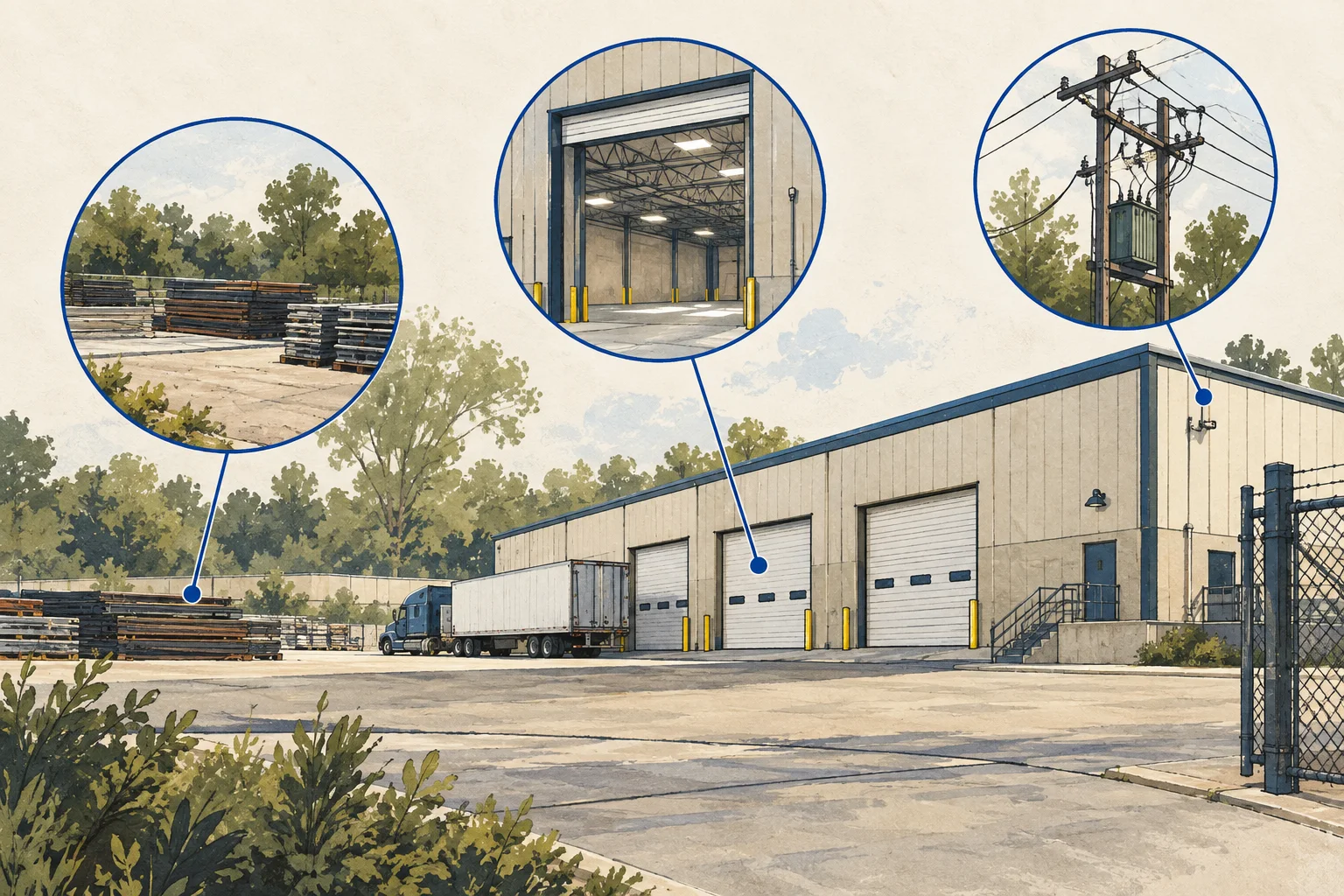
Conceptual illustration of industrial building, yard, loading and process-use boundaries

What changes the decision

Read the operating model before the headline

01

Activity matters more than the label

EPA’s industrial stormwater guidance organizes concerns around activities and exposure, including storage, handling and maintenance. Treat industrial zoning or a warehouse label as a reason to investigate the actual operation. Record what happens outdoors, what materials are handled and which authority governs relevant approvals. This guide does not conclude that any particular permit is required or satisfied.

Source 1
02

A building metric can miss the constraint

Floor area alone does not describe a truck movement, a power requirement or a tenant’s exclusive yard. Ask what the operation needs to do and where it does it. Keep dimensions, legal rights and operating permissions as separate evidence. A visible paved area can be physically useful while its inclusion in the lease remains unresolved.

03

Use the parent page to route work

Choose small-bay for bay-level leases and access, logistics for goods movement, cold storage for temperature systems, manufacturing for process fit, or IOS for the parcel-to-yard relationship. Some properties need two workflows. The purpose is to select documents and reviewers, not to force every industrial opportunity into one standardized assumption set.

Keep these separate

Three distinctions to preserve in the file

Evidence or situationWhat it tells youWhat to establish next
Building-led operationInterior configuration is central to the useRequest measured plans, system records and lease boundaries for the actual activity.
Yard-led operationOutside storage or movement is centralEstablish parcel relationships, usable geometry, access rights and permission evidence.
Process-led operationProduction equipment and utilities drive fitSeparate owned real estate from process assets and review utility and permit dependencies.
Conceptual illustration of industrial building, yard, loading and process-use boundaries

A practical review sequence

Build a file another reviewer can follow

Use the sequence below to turn the initial description into specific document requests. Preserve contradictory records instead of choosing the more favorable version.

  1. Write the operation in verbs

    Describe receiving, storing, assembling, maintaining, dispatching or refrigerating instead of repeating the marketing category. Include outdoor activities and anticipated hours. This short operating description gives zoning, environmental and engineering reviewers the same question rather than asking each to evaluate an undefined industrial use.

  2. Connect the physical areas

    Request a boundary survey, building plans and the lease or ownership schedule. Mark which party controls each loading area, drive, outside storage zone and utility connection. Do not add adjacent space to the operating footprint because it appears continuous in an aerial image.

  3. Select the technical branch

    Identify the constraint most likely to change the research plan. A refrigerated operation needs a system review; an equipment yard needs a rights and permission review; a multi-tenant building needs a bay schedule. Send the file to the relevant child kit while retaining shared identity records.

  4. Produce a scoped handoff

    Prepare a one-page note with the described operation, supporting documents, disputed areas and the next responsible reviewer. AI can summarize supplied evidence and draft precise requests. It cannot verify lawful use, measured capacity or environmental condition from the asset category or the absence of a search result.

Questions that arise during review

Resolve the ambiguity before the model

Does this replace the small-bay kit?

No. The industrial page routes visitors to the appropriate specialist workflow, including the existing small-bay resource. A broad industrial guide should preserve those useful entry points while explaining when a different kit is needed.

Can a warehouse also be IOS?

It can contain a meaningful outside-storage component, but the relationship must be documented. Keep building space and yard rights separate in the file, including any different parcels, leases, approvals and access arrangements.

What should an AI sourcing filter include?

Start with observable criteria and their provenance, such as building configuration, stated operation and supplied lease boundary. Mark utility capacity and permissions as unresolved until supported. A sourcing filter should help prioritize investigation, not imply that screened properties are approved for use.

From the page to your next task

Start with the useful output.

Operating activity and property-control map

Build an editable operating activity and property-control map, retain document references and open decisions, then export your team's working file.

Scope: industrial building, yard, loading and process-use boundaries

Bring
An optional file nickname Status, observations and document references for the four evidence items; unknown is acceptable
Leave with
Operating activity and property-control map with editable, expandable records and document locators Two fictional worked rows showing mismatches and decisions to review CSV and readable text exports with row provenance, method sources and edition A separate document-request companion with suggested reviewers

Edition 2026-09-30.1

Put the reviewed inputs to work

Continue with a relevant template.

The Complete Claude Playbook: Commercial Underwriting

After identifying the industrial operation and premises, use the commercial playbook to organize lease evidence for underwriting. Its contract workflow does not verify utility capacity, loading geometry, yard permission or equipment condition.

Explore the existing resource ↗

Evidence and scope

Follow each claim to its source.

Commercial Real Estate Lending, Comptroller’s Handbook, version 2.0

Office of the Comptroller of the Currency · Checked 2026-09-30

March 2022 supervisory handbook; lease review, property income, re-leasing costs and property-type distinctions.

  • Bank supervisory guidance, not a property appraisal, current market survey or universal financing standard. No handbook percentage is adopted as a deal assumption.
Open original source ↗
Stormwater Discharges from Industrial Activities

U.S. Environmental Protection Agency · Checked 2026-09-30

Industrial activities and exposure pathways, with state and federal permitting context.

  • Activity and jurisdiction determine applicability. The expired 2021 federal general permit is not presented as a new applicant’s permit.
Open original source ↗
Warehousing: Hazards and Solutions

Occupational Safety and Health Administration · Checked 2026-09-30

Warehouse work areas, powered vehicles, loading docks and related operational hazards.

  • Safety guidance does not establish truck access rights, structural adequacy, approved storage configuration or code compliance at a property.
Open original source ↗