

Clinical fit-out and leases

Medical office review: test the specialty before the suite

Medical-office research should identify the clinical activity before judging a suite’s fit. Consultation rooms, imaging, procedures and laboratory testing create different system and permission questions. AI can organize the tenant’s requirements, lease obligations and fit-out records, but the medical-office label does not establish that another specialty can occupy the space without further work or approvals.

NextAutomation editorial research method. Public sources establish the framework; the worksheet example is fictional and no property has been verified.

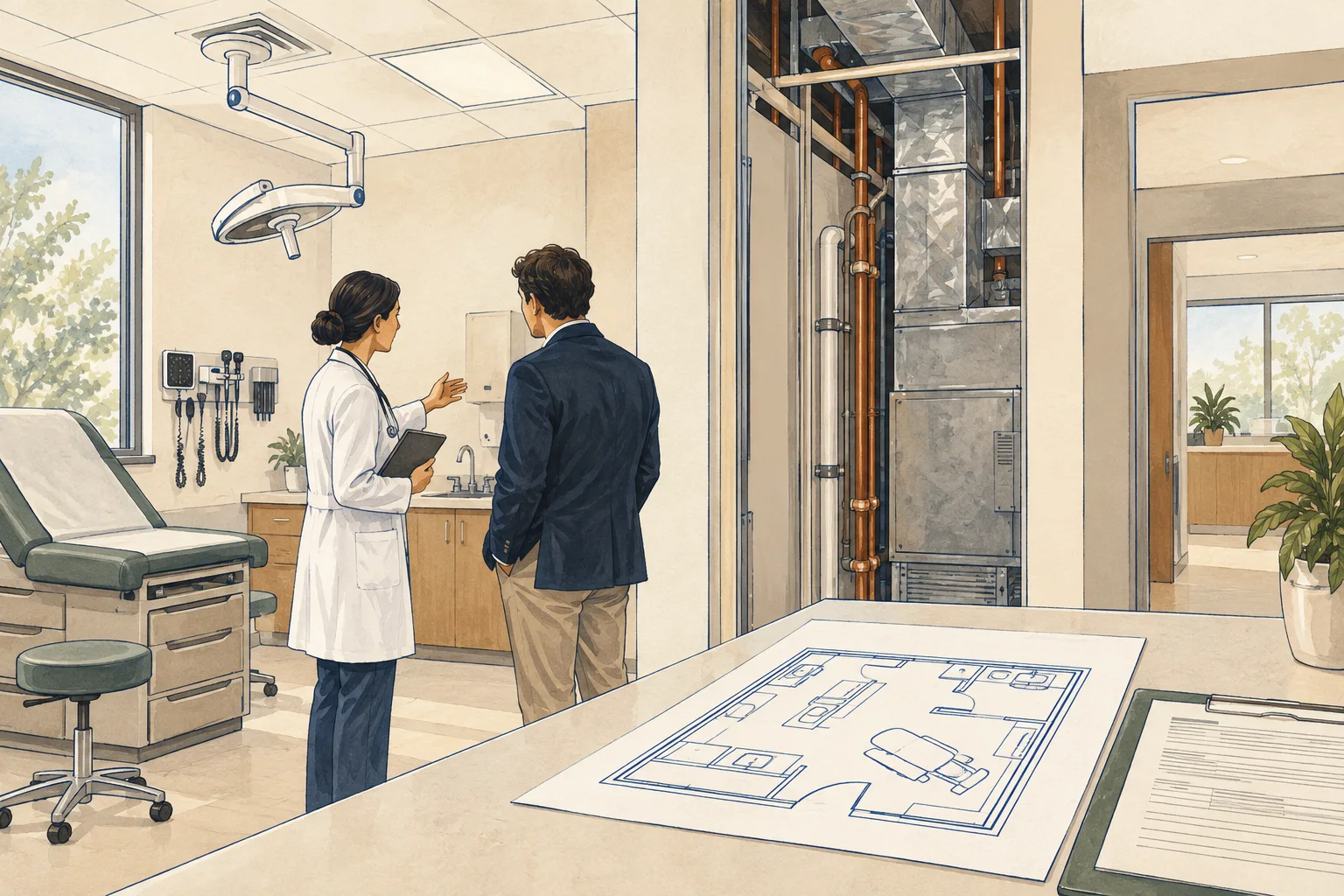
Conceptual illustration of medical-office specialties, fit-out responsibilities and tenant transitions

What changes the decision

Read the operating model before the headline

01

Specialized work changes reletting

The OCC’s office discussion identifies medical offices as having specialized fixtures and systems. Translate that distinction into a suite-specific review: what was built for the existing practice, who owns it and what a replacement occupier needs. Do not assume a former clinical use makes every improvement reusable or that the quoted office area reflects clinical operating capacity.

Source 1
02

The activity determines the permission question

Ask whether the suite supports consultations, procedures, diagnostic equipment or testing. CMS’s CLIA program is relevant to covered human laboratory testing, not automatically every medical-office tenant. Keep applicable certifications and permissions tied to the actual activity and legal entity. A healthcare business name alone does not identify the scope of regulation or the property’s readiness.

Source 1
03

Lease continuity is separate from practice continuity

A practice sale, provider change or brand affiliation may not produce an automatic lease assignment. Review the tenant entity, guaranty, consent provisions and alterations. Preserve proposed business changes as scenarios until documents establish their effect on the premises. The acquisition team needs property obligations without treating the practice’s patient revenue as landlord rent.

Keep these separate

Three distinctions to preserve in the file

Evidence or situationWhat it tells youWhat to establish next
General clinical suiteShows a prior or proposed healthcare useIdentify the actual specialty, system requirements and relevant permissions.
Specialized fit-outMay support a particular process or deviceConfirm ownership, condition, removal duties and compatibility with the next user.
Practice affiliationProvides business contextEstablish the legal tenant and executed assignment or guaranty rather than assuming institutional support.
Conceptual illustration of medical-office specialties, fit-out responsibilities and tenant transitions

A practical review sequence

Build a file another reviewer can follow

Use the sequence below to turn the initial description into specific document requests. Preserve contradictory records instead of choosing the more favorable version.

  1. Write the clinical activity brief

    Ask the prospective occupier to describe the services and equipment relevant to the premises without patient information. Record hours, utility and access needs, and any proposed change from the former use. This gives technical and regulatory reviewers a concrete scope rather than the vague question of whether the suite is medical.

  2. Collect the physical evidence

    Request as-built plans, system schedules, alteration records and equipment ownership documents. Separate landlord systems from tenant devices and removable improvements. Ask qualified engineers to identify capacity or modification questions. AI can index the records but should not certify ventilation, shielding, power or procedure-room suitability.

  3. Review the property contract chain

    Obtain the executed lease, amendments, guaranty and assignment or change-of-control provisions. Link alteration and restoration obligations to the relevant systems. Keep a proposed renewal distinct from an executed one. Ask counsel which consents are required before describing a practice transition as a confirmed continuation of the existing tenancy.

  4. Prepare a specialty-specific handoff

    List missing evidence for the tenant, engineer, landlord and appropriate regulatory reviewer. Include the documents needed to understand reletting work and responsibility. The output is a practical review sheet, not a clinical license, operating approval or forecast of the practice’s financial performance.

Questions that arise during review

Resolve the ambiguity before the model

Is medical office the same as a healthcare facility?

It can overlap in ordinary language, but this guide focuses on outpatient suites and their leases and fit-out. A licensed operating facility with beds, complex care operations or a master lease needs the separate healthcare-facility review as well.

Does every medical tenant need CLIA certification?

No. The question depends on whether the activity falls within the program’s scope. Record what testing is actually proposed and ask the appropriate specialist. Do not apply a laboratory requirement merely because a tenant provides healthcare services.

Can AI assess the value of existing fit-out?

It can inventory documented improvements and identify missing ownership or condition information. Reuse and value require technical and market review. This kit does not assume that specialized work is valuable to every successor or that its original cost equals current value.

From the page to your next task

Start with the useful output.

Clinical use and suite-fit register

Build an editable clinical use and suite-fit register, retain document references and open decisions, then export your team's working file.

Scope: medical-office specialties, fit-out responsibilities and tenant transitions

Bring
An optional file nickname Status, observations and document references for the four evidence items; unknown is acceptable
Leave with
Clinical use and suite-fit register with editable, expandable records and document locators Two fictional worked rows showing mismatches and decisions to review CSV and readable text exports with row provenance, method sources and edition A separate document-request companion with suggested reviewers

Edition 2026-09-30.1

Evidence and scope

Follow each claim to its source.

Commercial Real Estate Lending, Comptroller’s Handbook, version 2.0

Office of the Comptroller of the Currency · Checked 2026-09-30

March 2022 supervisory handbook; lease review, property income, re-leasing costs and property-type distinctions.

  • Bank supervisory guidance, not a property appraisal, current market survey or universal financing standard. No handbook percentage is adopted as a deal assumption.
Open original source ↗
Property Types in Portfolio Manager

ENERGY STAR · Checked 2026-09-30

Building-use categories for energy benchmarking, including mixed use, medical office and laboratories.

  • Benchmarking categories are not zoning classifications, licenses or certifications that a proposed use fits a building.
Open original source ↗
Clinical Laboratory Improvement Amendments

Centers for Medicare & Medicaid Services · Checked 2026-09-30

Program context for laboratory testing on humans for health assessment, diagnosis, prevention or treatment.

  • Not every medical office or research laboratory performs CLIA-covered testing; no facility certification was checked.
Open original source ↗