

Tennessee / Premises and facility scope

Tennessee medical property: identify the premises and facility

A Tennessee medical-office label can hide several different businesses and property obligations. Start by identifying the premises, the operating practice and any regulated healthcare facility as separate entities in the acquisition file. Then connect the proposed tenant activity to its own documents and the building’s physical requirements, without treating a practitioner’s credentials as evidence that every part of the property is ready for that use.

Tennessee Health Facilities Commission’s division overview supplies the regulatory context. No license search, clinical assessment or facility-specific applicability determination is provided.

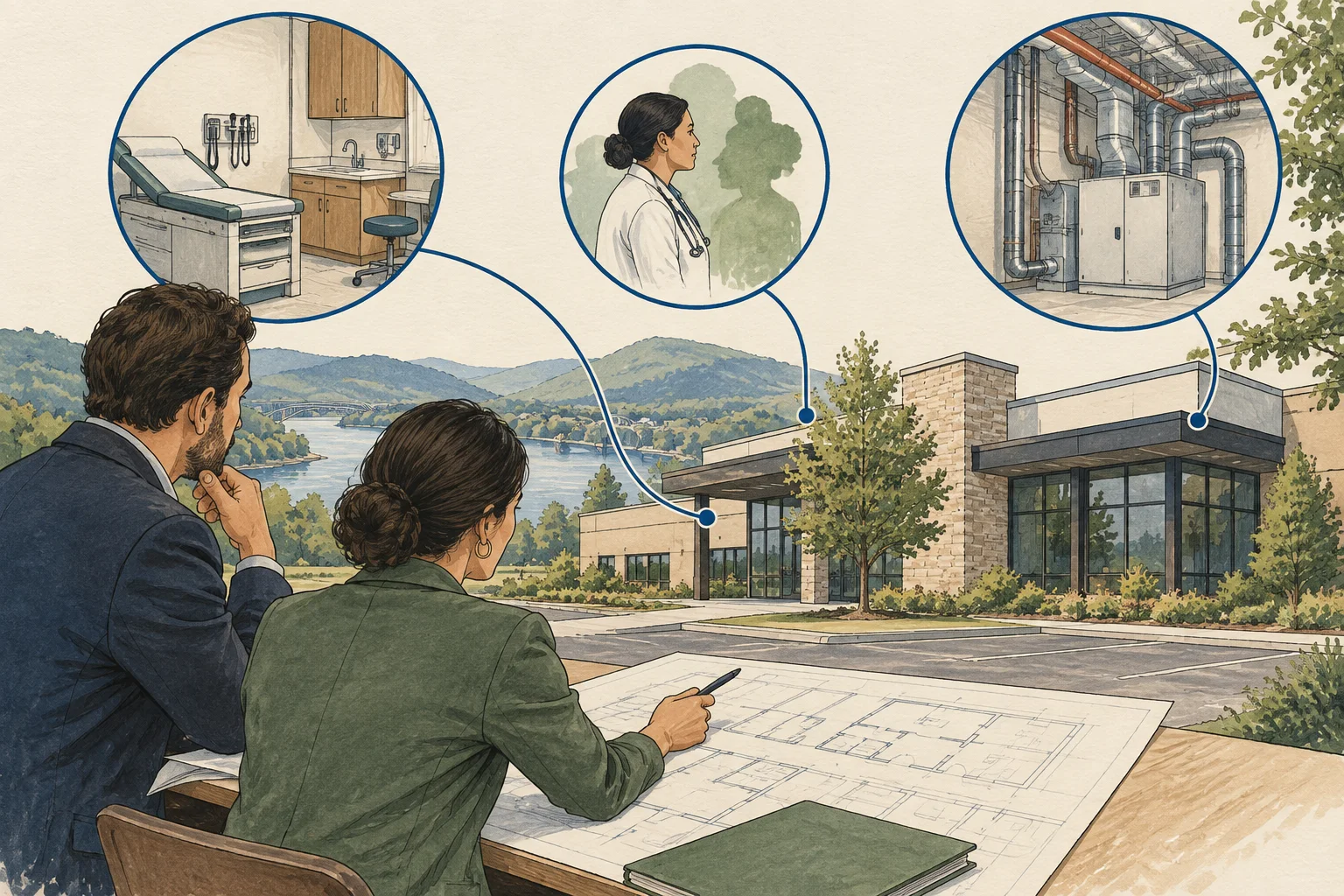
Conceptual illustration of documents and decisions for Tennessee commercial property research

What changes the decision

Tennessee medical office: separate the building, the practice and the licensed facility

01

Facility regulation has a distinct scope

Tennessee’s Division of Licensure and Regulation describes responsibility for healthcare facilities including hospitals, nursing homes and ambulatory surgical treatment centers, and provides facility and plan-review resources. Use the relevant facility category to frame the inquiry. Do not assume a generic office tenant description tells you whether a particular facility regime applies to the proposed activity.

Source 1
02

The leased premises and operating identity must match

Build a crosswalk between the lease entity, trade name, suite and supplied operating documents. Record shared reception, diagnostic areas and support rooms explicitly. When the practice occupies only part of a building, keep its evidence attached to that premises rather than allowing a facility description to characterize every rentable space.

03

Specialized fit-out is a transaction responsibility question

Ask which installed systems and improvements belong to the landlord, tenant or equipment provider, and what the lease says about maintenance and removal. The acquisition team needs to know which operating assumptions survive a tenant change. A healthcare-related sign does not establish the condition, ownership or replacement burden of the systems behind it.

Read the records together

Evidence and its investment use

EvidenceWhat it establishesNext decision
Property and lease recordsThe premises and commercial responsibilities represented in the transaction.Match each operating entity to the space it actually occupies.
Applicable facility documentsThe supplied regulatory evidence for a defined activity.Have the specialist clarify scope and any proposed-change review.
Fit-out and equipment scheduleThe assets and responsibilities supporting the operation.Identify ownership, maintenance and re-leasing dependencies.
Conceptual illustration of the Tennessee research workflow

Put it to work

Healthcare premises and responsibility review

This worksheet organizes the questions that belong to the property buyer, healthcare operator and regulatory specialist. It does not ask an acquisition analyst to make clinical or licensing judgments.

  1. Identify the actual tenant activity

    Ask the operator to describe services and supporting spaces in plain language. Attach the current premises plan and distinguish the existing operation from a proposed addition or replacement tenant. Avoid reducing several different activities to a single medical-office category before the responsible reviewer sees the details.

  2. Route the regulatory question correctly

    Use the Health Facilities Commission’s official division resources to identify the appropriate facility-review path where relevant. Request the documents applicable to the described operation and have a qualified reviewer explain scope. Keep professional credentials, facility records and property approvals as distinct evidence rather than substituting one for another.

    Source 1
  3. Reconcile the fit-out and lease obligations

    Request the equipment and improvement schedule, lease responsibility clauses and maintenance records. Match specialized rooms and systems to the premises plan. Ask the technical and lease reviewers to flag components that could alter the landlord’s obligations, downtime assumptions or replacement-tenant plan.

  4. Prepare the re-leasing decision

    Summarize the current documented operation and the dependencies of any proposed change. Assign each unresolved question to the healthcare, property or technical reviewer who can answer it. Export the kit so the buyer can distinguish ordinary lease questions from activity-specific requirements and fit-out risks.

Before the next conversation

Questions this review should answer

Does a clinician’s license establish the building’s permitted use?

It addresses a different subject. The property and facility questions need their own records and qualified review. Keep the practitioner, operating entity and premises distinct so an acquisition memo does not use a professional credential as a substitute for building or facility evidence.

Can another medical tenant use the existing fit-out unchanged?

That depends on the proposed activity and the actual systems, documents and responsibilities. Describe the replacement operation and have the relevant reviewers assess it. Record any reuse assumption as conditional until the technical and regulatory questions for that proposal have been addressed.

Where can AI help the acquisition team?

AI can create the entity-and-suite crosswalk, extract lease responsibility clauses and flag missing equipment references. It should preserve document locations and distinguish observed text from interpretation. The specialist reviewers decide applicability, technical suitability and the consequences of a change in operation.

From the page to your next task

Start with the useful output.

Clinical-premises and improvement register

Build an editable clinical-premises and improvement register, retain document references and open decisions, then export your team's working file.

Scope: Healthcare premises

Bring
A working file name; use a non-sensitive label for your project. Your document references and observations, or leave missing evidence marked unknown.
Leave with
Clinical-premises and improvement register with editable, expandable records and document locators Two fictional worked rows showing mismatches and decisions to review CSV and readable text exports with row provenance, method sources and edition A separate document-request companion with suggested reviewers

Edition 2026-09-30.1

Evidence and scope

Follow each claim to its source.

Division of Licensure and Regulation

Tennessee Health Facilities Commission · Checked 2026-09-30

Healthcare-facility regulatory scope and official licensure, facility-map and plan-review resource paths.

  • Does not determine which requirements apply to an individual medical-office tenant, practice or building.
Open original source ↗