New York commercial property research, county by county
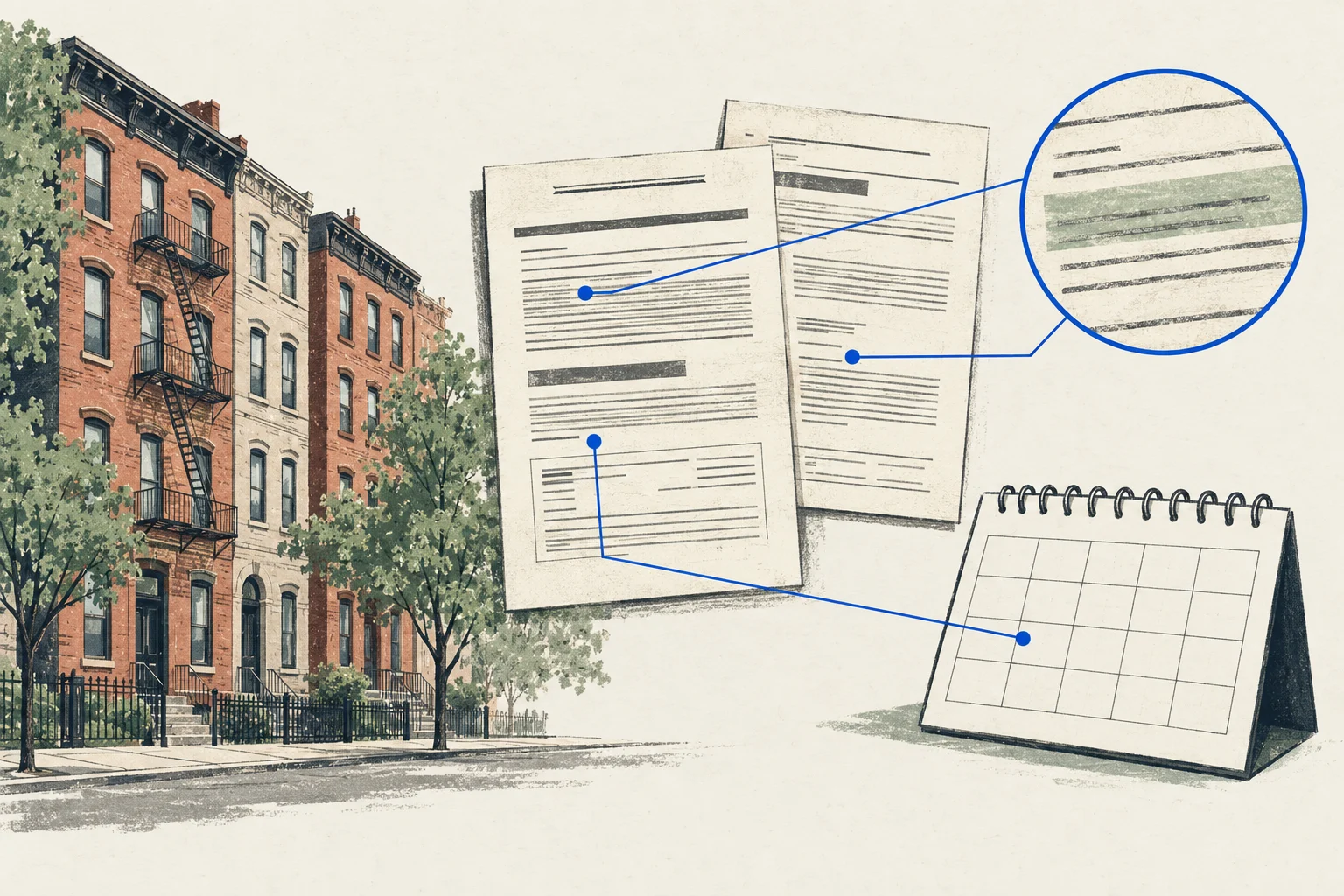
Start any New York commercial real estate search with the property identifier, its local jurisdiction and the acquisition decision you need to make. Then connect assessment, recorded ownership, land-use approvals and operating documents to the same property. The directory and working kit below support every county and any CRE asset type; choose the relevant asset guide when the operating details need a deeper review.
Statewide starting points for all 62 counties, including the five New York City counties. Local assessment and land-use responsibilities must be confirmed for the property. The six-district NYC loan study below is a focused example.
Start with the property, the place and the decision.
01
Choose the jurisdiction before the database
Keep the county, city or town and assessing unit together. A county name alone is not a complete assessment lookup. In NYC retain the county, borough and borough-block-lot identifier; outside NYC keep the local parcel identifier used by the responsible office.
Use the municipal assessor for the assessment record, the recording office for deeds and mortgage instruments, and the responsible local land-use office for the proposed activity. An assessment classification, recorded transaction and permitted operation answer different questions.
The statewide workflow is the same starting point for a warehouse, shopping center, apartment building, hotel or development site. What changes is the operating evidence: units, suites, bays, sites, keys, acres, licenses and contracts. Define that denominator before you compare documents.
Find the right record office
Start with the jurisdiction.
All 62 New York counties, including the five NYC counties. Choose the county for your property, then follow the parcel, document and approval paths for any CRE asset type.
Record paths across New York
Select a county, then identify the property municipality. Outside NYC, assessment and land-use routes depend on the city, town or village; NYC has its own assessment and recording paths.
01
Parcel and assessment
Outside NYC, use the Municipal Data Portal to select the county and municipality, find local officials and reach the assessment roll. Within NYC, use Department of Finance assessment records.
Outside NYC, use the official county website to locate the county clerk and its land-record access instructions. Confirm available document images and any access requirements. NYC uses ACRIS for four boroughs and the Richmond County Clerk for Staten Island.
Use the municipality identified in Municipal Profiles to locate planning, zoning and building officials. Confirm who administers the proposed use and obtain the relevant approval and permit record.
Jurisdiction names and FIPS identifiers: U.S. Census, January 2025. These official entry points help you locate the responsible office. Confirm the available records, access terms and currency for the property you are researching.
Five evidence tracks
Build one connected file across the record offices.
Research question
Starting record or custodian
Useful next action
Parcel and assessment identity
Local assessment or GIS record, identifier and record date.
Reconcile the address, parcels and improvements being purchased.Source 1
Recorded ownership and instruments
Responsible recording office; use the NYC-specific path only for the relevant borough.
Retain deed or instrument identifiers and request the documents needed for title review.Source 1
Permitted use and approval conditions
Responsible local land-use office, decision documents and referenced plans.
Describe the intended activity and ask which approvals and conditions govern it.
Operating and underwriting inputs
Seller or operator records, leases, agreements and dated schedules.
Keep observed document terms separate from assumptions and unanswered requests.
Site and development constraints
Relevant maps, surveys, access documents and professional reports.
Assign the exact site question and missing evidence to the appropriate reviewer.
From county choice to a review file
Use the same sequence anywhere in the state.
Choose your county or locality above, then open the statewide kit. Start one row per property and evidence question; retain separate rows where documents disagree.
01 / Define the acquisition scope
Name the property, asset type, parcels and proposed use. Record whether you are reviewing the land, improvements, operating business or a combination. A mailing address is a starting clue; retain the official identifier once located.
02 / Identify the record custodians
Locate the municipal assessing unit through the state directory. Confirm the county recording office and land-use authority separately. In New York City, route recorded documents through the appropriate borough office; Richmond uses its county clerk.
Keep a document identifier, date, page or exhibit reference and a short observed fact in the register. If the file is missing, inaccessible or inconsistent with another record, retain that status instead of inserting a guessed answer.
04 / Request the asset-specific evidence
Use the asset guide to identify the operating records this acquisition needs. Tie rent, inventory, area or capacity figures to a defined unit and date. Public records help establish context; operating assumptions require their own supporting files.
05 / Export the file and assign the open decisions
Download the evidence register as CSV or text. Give each unresolved question a next request and a reviewer. A completed row organizes the work; acceptance of the documents and any legal, engineering or underwriting conclusion remain separate review steps.
Any asset, a specific evidence request
Choose the operating lens that fits your acquisition.
Asset family
Evidence to request
Decision it helps prepare
Multifamily, student or senior housing
Approved residential use, unit schedule, occupancy records and applicable program or operating restrictions.
Reconcile the unit count and permitted operation with the rent roll before underwriting income.
Industrial, logistics, small bay or outdoor storage
Permitted activity, building and yard footprint, access and any conditional approvals.
Connect the intended operation to the specific parcel and approval documents.
Retail, office, medical office or mixed use
Suite and use schedule, leases, tenant improvements and occupancy or use approvals.
Keep the marketed tenancy separate from the use and premises established by the documents.
Hospitality, self-storage, manufactured housing or other operating assets
Property records plus the operating agreements, site inventory and relevant licenses or approvals.
State whether the acquisition includes real estate, an operating business or both.
Land, development, agriculture or timberland
Parcel boundaries, access rights, development conditions, site constraints and intended-use documents.
Identify what still requires local, title, environmental or engineering review before valuing the proposed use.
Focused example / Six NYC community districts
A property universe and a document queue answer different questions.
Use the property totals to understand the study boundary and the document count to size the next review task. The report had not yet extracted observed maturities. Its next step is reading and checking the documents, before building any dated maturity bands. Our table-total check confirms the arithmetic printed in the report; it does not reproduce the underlying parcel query.
A defined six-district property universe
The district columns sum to 79,975 screened tax lots, 19,515 existing multifamily lots, 356,554 residential units and 9,603 development-screen candidates. Those are different units and universes. The PDF does not include the parcel-level records needed to reproduce the screen.
NYC six-district loan research · August 2026 · PDF pages 1. We checked this arithmetic, not the underlying records.
8,083 records to examine; zero observed maturities extracted
The reported funnel goes from 19,515 eligible properties to 15,923 with a mortgage record, 8,955 with no later recorded satisfaction, and 8,083 with a retrievable post-2003 document image. The final stage is explicitly zero observed maturities extracted. Zero extracted dates does not mean zero loans maturing.
NYC six-district loan research · August 2026 · PDF pages 2, 3. Reported in the supplied edition.
Observation before interpretation
Decide what each record can support.
What you have
What you can record
What still needs review
A mortgage recording date
The recorded event and its date. Keep the mortgage record tied to the property identifier.
Read the terms before assigning a maturity. An assumed loan term added to a recording date is not an observed date.Source 1
A lender label or assignment classification
The name or classification reported for that record, including an unresolved category.
Establish the relevant document chain before treating that label as the current party to negotiate with.Source 1
No later satisfaction found in the study
The result of that recorded-document check, with its source and date.
Keep it as a research status. It does not by itself establish the current balance or that all outstanding obligations have been found.Source 1
An image reported as retrievable
A document available for the next reading task.
Locate the maturity language, check readability and review later amendments or extensions before accepting a date.Source 1
Optional specialist workflow / Mortgage documents
Build a maturity-evidence review brief.
For a debt-focused assignment, use the separate mortgage maturity kit. The statewide register remains your starting tool for other acquisition questions; this specialist workflow applies only when you need to establish terms from the instrument chain.
01 / Keep the search boundary visible
Record the study edition, district scope and property criteria. Name the unit you are counting. If your acquisition mandate extends beyond the six districts, treat the extra geography as a separate research assignment.
02 / Connect the property and the document
Keep the borough-block-lot identifier, document identifier and source reference together in your deal file. Note whether the row represents a property, instrument or loan. Send unresolved matches to review before counting them.
03 / Capture the evidence for the date
When a document is available, preserve the exact maturity wording and page reference alongside the date you enter. If the image is unreadable or the term is absent, record that reason. Leave the date empty rather than filling it from an assumed term.
04 / Check what could change the conclusion
List later amendments, extensions, assignments or satisfactions that still need examination. Separate an option described in a document from evidence that it was exercised. Assign conflicting or incomplete terms to the appropriate reviewer.
05 / Summarize coverage before timing
Record how many items remain to locate, read, reconcile and review. Set an explicit as-of date before grouping accepted maturity dates into time bands. Preserve the unknowns so a smaller reviewed sample cannot appear to describe the entire cohort.
Before you start
Questions about statewide CRE research.
Does this guide work in every New York county?
Yes. The directory includes all 62 counties, and the primary kit accepts any New York county and municipality. The supplied loan study covers only six NYC community districts. Its findings are an example, not property data for the rest of the state.
Is this limited to one property type?
No. The primary guide and kit work across CRE assets. Choose the relevant asset guide for operating questions, such as apartment units, retail suites, hotel keys, storage inventory or industrial use. The specialist study and its kit remain optional.
Where should I start looking for New York property records?
Begin with the county and municipal assessing unit. Use the state assessment directory for the local roll and responsible official. Find the recording office separately: ACRIS serves four NYC boroughs, while Staten Island documents go through the Richmond County Clerk.
AI can organize identifiers, extract candidate fields from documents you provide, compare versions and draft missing-evidence requests. Keep the source locator with each observation and have the relevant reviewer accept it. A name match, parcel class or recorded mortgage event does not establish seller intent, current income or an investment recommendation.
What will I leave the statewide kit with?
An editable property-and-evidence register with local jurisdiction, asset type, document custodian, record locator, observed fact, unresolved question and next reviewer. Export it as CSV or text to assign the next research work. Two fictional examples show how to retain mismatches; the blank file contains your entries only.
From the page to your next task
Start with the useful output.
Statewide working kit
New York statewide property evidence register
Build a New York property evidence register from your documents and export a file with clear research requests and review owners.
Scope: Any CRE asset across all 62 New York counties, including every NYC borough.
Bring
Local jurisdiction and property identifier Asset type and acquisition question Documents available and unresolved requests
Leave with
Editable property-and-evidence register for any county and CRE asset Two fictional examples spanning different assets and jurisdictions CSV and readable text exports with document locators and review requests
Keep the observed loan terms, document references and amendment questions together, then download the next-review brief.
Scope: Review one property and instrument. The source study covers six NYC districts; the worked example is fictional.
Bring
A property nickname, district and available instrument references. Recorded-date and explicit maturity evidence, if available; leave missing fields unknown.
Leave with
A downloadable plain-text mortgage evidence sheet. Four review tasks covering record location, maturity evidence, amendments and unresolved checks.