


Phase 1 ESA Checklist: How to Review a Phase I Report Before You Close
Use this Phase 1 ESA review checklist to track report dates, open findings and document references before closing, with an illustrative closing review register.

Phase 1 ESA Checklist: How to Review a Phase I Report Before You Close
Phase 1 ESA checklist: the short answer
Review the report’s scope and property identity, component dates, professional conclusions and unresolved findings before relying on a Phase I environmental site assessment. This is a buyer’s document-review checklist, not a replacement for performing the assessment.
EPA’s All Appropriate Inquiries guidance recognizes ASTM E1527-21 and E2247-23, the latter for forestland or rural property. EPA states that AAI must be conducted or updated within one year before acquisition; interviews, government-record review, site inspection and cleanup-lien searches require a 180-day check. An environmental professional must address the applicable requirements.
Check dates against the planned acquisition date
Create a date register from the underlying activity dates. The cover-page date alone is not enough to establish when each activity occurred. If closing moves, recalculate the register and ask the environmental professional which components need updating.
| Review field | Capture | Action |
|---|---|---|
| Planned acquisition | Current target date and revision | Recheck when the date changes |
| Component activities | Individual completion or update dates | Compare with applicable window |
| Overall inquiry | Completion/update and scope | Confirm currency with professional |
| Reliance | Named user, property and engagement scope | Obtain reviewer confirmation |
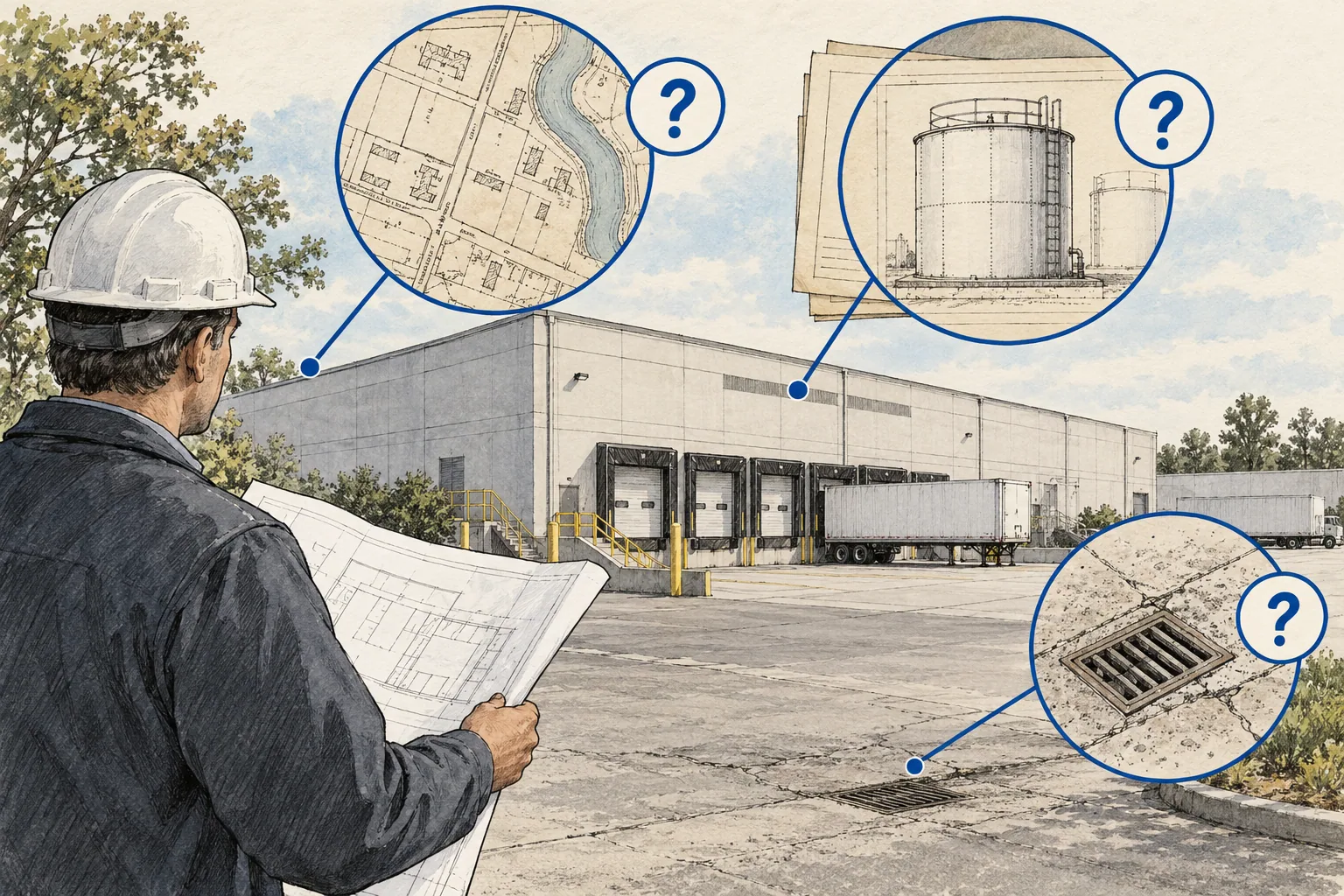
The Phase I ESA review checklist
| Item | Record in your file | Escalate when |
|---|---|---|
| Property identity | Address, parcels and assessed boundaries | The deal includes an omitted parcel |
| Standard and scope | Edition, deviations and limitations | The required scope is unclear |
| Professional conclusions | Exact section and page | Finding has no next action |
| Data gaps | Missing evidence and significance | The gap affects a conclusion |
| Supporting records | Dates and references | A component needs an update |
| Follow-up | Requested work, owner and deadline | The next step is unassigned |
Read the conclusions alongside the appendices and limitations. A database no-match does not settle a concern described in a site visit. Ask the environmental professional to explain the relationship rather than allowing a summary tool to choose whichever sentence sounds more reassuring.
Worked example: an illustrative closing register
This fictional acquisition is scheduled for October 30, 2026. A site inspection dated March 1 is 243 days earlier; a government-record review dated August 15 is 76 days earlier. The first row needs professional attention even if the report cover is dated September.
| Component / issue | Evidence | Review status | Next owner |
|---|---|---|---|
| Site inspection | March 1, 2026 | Outside the 180-day comparison | Environmental professional: scope update |
| Government records | August 15, 2026 | Inside the date comparison | Reviewer: confirm scope |
| Missing tank closure record | Conclusion p. 12, appendix request | Open finding | Seller: obtain record; professional: evaluate |
| Additional parcel | Purchase schedule includes parcel B | Scope not established | Counsel and professional: reconcile boundaries |
“Inside the date comparison” does not mean the report is acceptable. Scope, findings, reliance and other requirements still need review. Keep each issue separate so a fresh search date cannot accidentally clear an unresolved condition.
What AI can and cannot do
Ask AI to index the supplied report into this register, cite the page beside each date or finding and return “not supplied” for missing evidence. Verify selected rows against the original, especially conflicting dates and limitations. AI cannot perform the professional assessment, provide environmental clearance or establish liability protection.
Use NextAutomation’s screening and underwriting workflow as the recommended implementation for organizing acquisition evidence, with the document types and checklist agreed during setup. Environmental judgments remain with the responsible professionals.
Turn the register into the next diligence request
Each open row should state the question, required document, responsible person and deadline. That is a usable handoff; a report summary without owners is not. Link the accepted response back to the original row rather than erasing its history.
Continue with the land acquisition diligence guide and the deal-screening case study for the wider intake and completeness workflow.
Frequently asked questions
How long is a Phase 1 ESA good for?
EPA describes a one-year AAI window with specified components checked within 180 days before acquisition. Have the environmental professional verify the actual component dates and requirements for your transaction.
What should a buyer record from a Phase I ESA?
Capture property identity, scope, component dates, conclusions, data gaps and next actions, with page references and an owner for each open item.
Can AI review a Phase I ESA?
AI can organize supplied text and flag missing fields for review. It cannot replace the environmental professional or clear a property.
Who should decide whether more investigation is needed?
The environmental professional evaluates environmental findings. The buyer and counsel also need to address the transaction’s reliance and legal requirements.
Related Articles
How to Build a Submarket Intelligence Report With AI
Build a CRE submarket report with dated sources, comparable definitions, a clear supply pipeline, and hypotheses your investment committee can test.
How to Find Off-Market Real Estate Deals With AI
Build an off-market CRE sourcing workflow with verified property signals, careful LLC research, buy-box screening, and a clear path to owner conversations.
AI Deal Screening for CRE: An Inbound Deal Playbook
Screen inbound CRE deals with a documented buy box, source checks, visible missing information, and a review path for scores, rejections, and overrides.