

Wisconsin / Cleanup and continuing duties

Wisconsin cleanup records: identify continuing obligations

For Wisconsin redevelopment, a completed-cleanup label should lead to the closure documents and any continuing obligations. Ask what remains relevant to the buyer’s proposed use, ground work and ownership responsibilities. Build a document-linked obligation register before treating a status field as a complete statement about future development, site maintenance or unrestricted use.

Wisconsin DNR’s RR Sites Map guidance supports the source path. This guide does not determine contamination, cleanup sufficiency or obligations for an individual property.

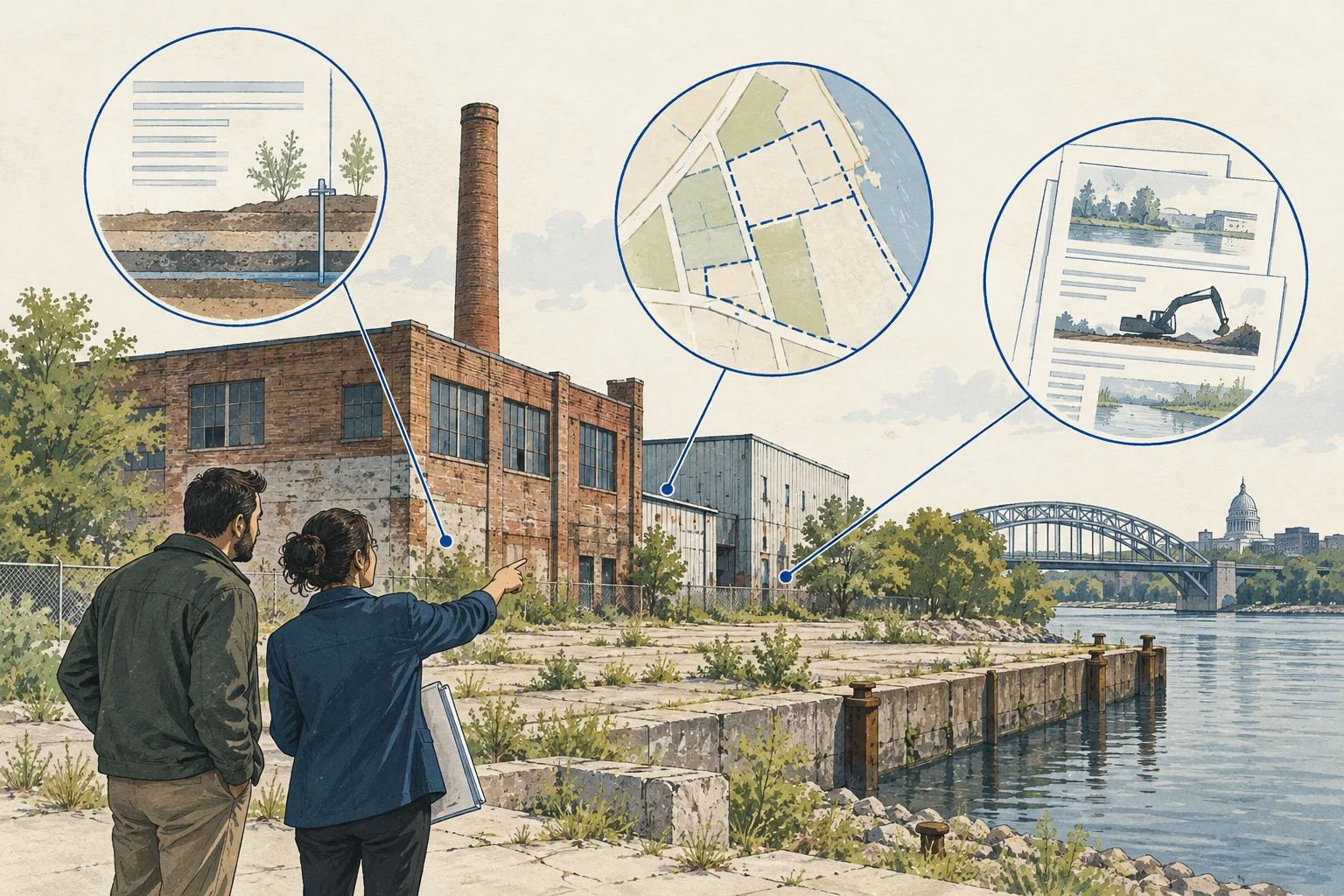
Conceptual illustration of documents and decisions for Wisconsin commercial property research

What changes the decision

Wisconsin redevelopment: read the continuing obligations behind a cleanup status

01

Completed cleanup can coexist with continuing obligations

DNR describes RR Sites Map as showing known contamination sites and some completed cleanups with remaining contamination or continuing obligations. The source also connects users to related activity information and documents. This is why the acquisition review should follow the record to its supporting file rather than compressing the status into a simple clean-or-not-clean label.

Source 1
02

The document controls the practical question

Request the closure-related documents, maps and any referenced obligations supplied for the property. Build a register of the described area, activity, responsible party and condition, with a document location for each entry. Have the environmental and legal reviewers explain applicability instead of paraphrasing a restriction so broadly that its actual scope disappears.

03

The buyer’s plan may touch a managed area

Give the reviewers the proposed excavation, utility work, resurfacing and change of use. Ask which plans or maintenance assumptions need to account for the documented obligations. A completed prior action may be compatible with the project, but that conclusion should come from a review of the actual documents and intended work.

Read the records together

Evidence and its investment use

EvidenceWhat it establishesNext decision
RR Sites Map or activity recordA location and status within a defined DNR source.Retrieve the supporting file and confirm the property match.
Closure and obligation documentsThe described conditions and their referenced scope.Build an attributed obligation register for review.
Proposed work and operating planThe buyer’s intended interaction with the site.Identify design, maintenance and transaction tasks that follow.
Conceptual illustration of the Wisconsin research workflow

Put it to work

Cleanup obligations and proposed-work review

The worksheet converts a cleanup-history packet into an obligation review. It does not estimate remediation costs or decide legal compliance; it makes the evidence and responsible questions easier to assess.

  1. Match the activity record to the acquisition

    Retain the DNR activity or site reference, location and search date for the selected record. Reconcile it with the current purchase boundary and any historical address changes. Preserve uncertain matches so a nearby or partly overlapping record is not silently treated as the entire property file.

    Source 1
  2. Read the referenced documents together

    Request the relevant closure correspondence, maps and supporting obligations. Make a chronology of the documents supplied and flag missing attachments. Extract the stated area and action precisely, then have the appropriate professionals confirm which conditions apply to the buyer’s proposed ownership and use.

  3. Compare obligations with the project plan

    Mark proposed excavation, utilities and operational changes on the plan supplied to the reviewers. Ask whether maintenance, notification or other tasks described in the file affect that work. Keep the reviewer’s interpretation separate from the original document text and record any additional agency clarification needed.

  4. Create the transaction responsibility schedule

    Assign each supported obligation or unresolved question to the appropriate owner, consultant or transaction reviewer role. Identify the evidence needed for closure of each task. Export the kit so the acquisition memo describes the actual status and remaining responsibilities without inventing a cost or unrestricted-use conclusion.

Before the next conversation

Questions this review should answer

Does completed cleanup mean unrestricted use?

DNR’s mapping guidance explicitly includes completed sites with continuing obligations. Read the specific documents and have the relevant professionals assess their scope for the proposed use. The status field alone is not enough to determine the buyer’s ongoing responsibilities or the conditions affecting future work.

Source 1
What should be in an obligation register?

The document reference, affected area, described action or condition, responsible reviewer and the buyer’s related project activity. Preserve the source wording in the underlying file while using a concise working summary. Record interpretation separately so later reviewers can see what was stated and what was concluded.

How can AI help without overstating the cleanup result?

AI can extract document references, build a chronology and flag project activities that need review against stated obligations. Require page or section locations and preserve uncertain matches. The environmental professional and counsel decide applicability; AI should not change a closure status into an unrestricted-use certificate.

From the page to your next task

Start with the useful output.

Activity-file and continuing-duty register

Build an editable activity-file and continuing-duty register, retain document references and open decisions, then export your team's working file.

Scope: Cleanup obligations

Bring
A working file name; use a non-sensitive label for your project. Your document references and observations, or leave missing evidence marked unknown.
Leave with
Activity-file and continuing-duty register with editable, expandable records and document locators Two fictional worked rows showing mismatches and decisions to review CSV and readable text exports with row provenance, method sources and edition A separate document-request companion with suggested reviewers

Edition 2026-09-30.1

Evidence and scope

Follow each claim to its source.

RR Sites Map

Wisconsin Department of Natural Resources · Checked 2026-09-30

Site-map scope, linked activity information and continuing obligations at certain completed cleanups.

  • No individual activity file was opened; a mapped status does not establish unrestricted use or project-specific obligations.
Open original source ↗