

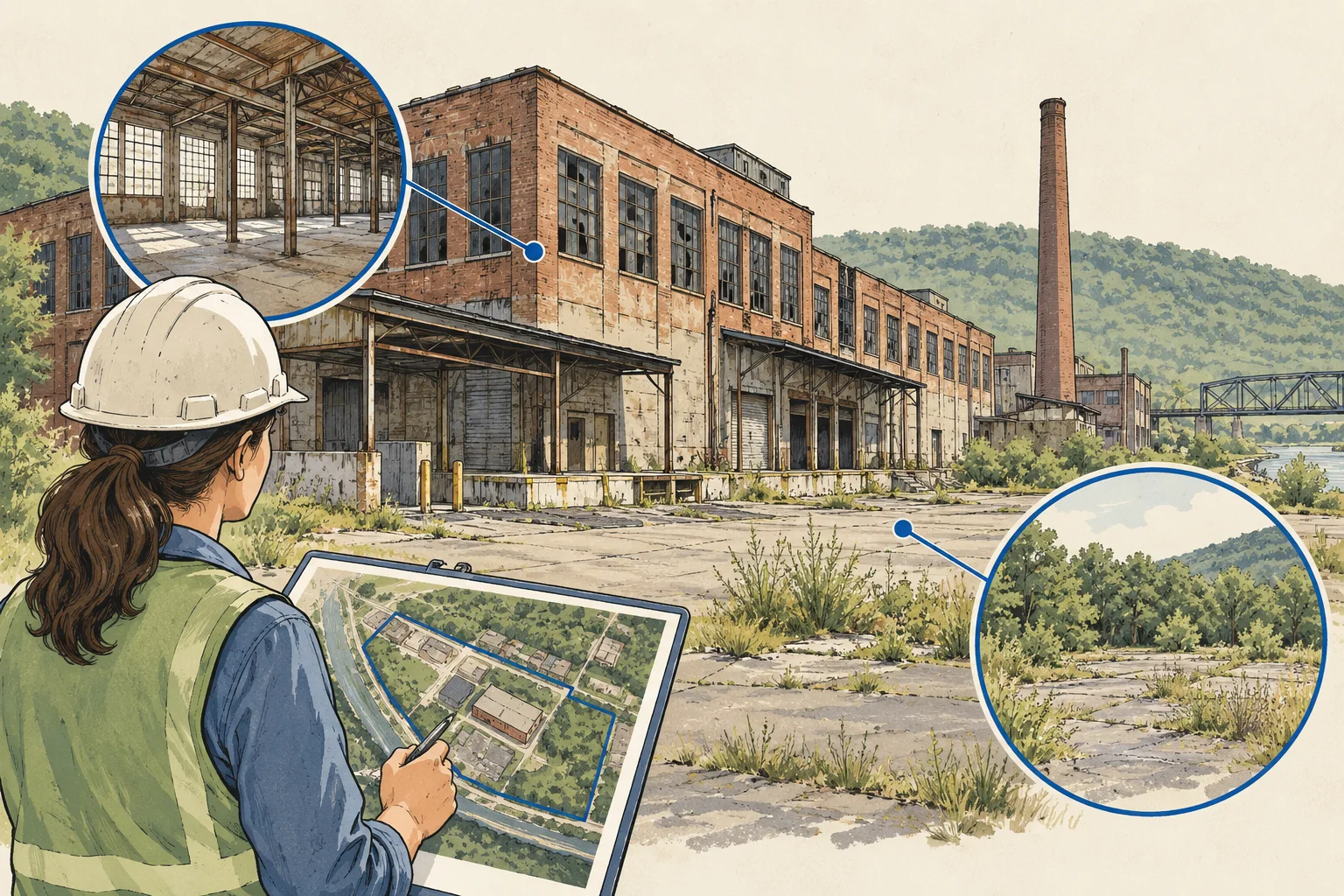
Pennsylvania / Targeted DEP record requests

Pennsylvania industrial reuse: scope the DEP file request

For a Pennsylvania mill, warehouse or former manufacturing property, a map result is an index into a file, not a complete account of the site. Start by identifying the historical operating footprint and the proposed acquisition boundary. Then use DEP’s public-record resources to request the relevant program documents and connect them to the actual reuse decision.

Pennsylvania DEP’s public-record guidance supports this editorial method. No property search, contamination finding or cleanup-status determination is supplied.

Conceptual illustration of documents and decisions for Pennsylvania commercial property research

What changes the decision

Pennsylvania industrial reuse: turn a mapped record into a targeted site-file review

01

Use the map to define the record request

DEP’s public-record page describes an Environmental Site Assessment Search Tool that organizes environmental information spatially and supports follow-up records research. It also provides informal file-review and formal records routes. The practical step is to retain the identified site, program and document question so the request can be scoped to the evidence the buyer actually needs.

Source 1
02

Historic operations may not follow today’s parcel lines

Build a reference plan showing the supplied historical operating area and current purchase boundary. Ask which former buildings, process areas or neighboring components appear in the environmental documents. Keep a record outside the parcel visible when a qualified reviewer considers it relevant, but do not label it a site condition merely because it is nearby.

03

Reuse changes the question being asked

A storage use, residential conversion and excavation program can require different reviews of the same history. Give the environmental and design professionals the intended proposal, not just a generic request to clear the site. Their conclusions should identify the evidence examined and what additional work remains before the acquisition assumptions can be treated as resolved.

Read the records together

Evidence and its investment use

EvidenceWhat it establishesNext decision
Spatial record searchAn identified record or program associated with a location.Use it to scope the document request and preserve search limits.
Program file and chronologyDocuments addressing particular activities and dates.Match the historical footprint and identify missing evidence.
Reuse-specific interpretationA qualified reviewer’s conclusion for the intended proposal.Translate unresolved questions into further assessment or design tasks.
Conceptual illustration of the Pennsylvania research workflow

Put it to work

Industrial reuse file-review brief

The kit creates a file-review brief for one industrial reuse proposal. It is designed to make the next request precise enough that the analyst, consultant and seller are discussing the same property and history.

  1. Define the site and the intended change

    Collect the current acquisition plan and any supplied historical plans or operating descriptions. Mark uncertainty rather than drawing a precise historic boundary without support. Describe the intended use and site work so the reviewer can explain which parts of the past operating history matter to this proposal.

  2. Record the search and selected program

    Use DEP’s public-record resources to locate the appropriate record path. Save the search scope, program identity and document references actually found. Where material is missing, prepare a targeted file-review request that identifies the location, activity and period rather than asking for an undefined clean-property confirmation.

    Source 1
  3. Build a document-linked chronology

    Organize the obtained documents by event and date, retaining the agency and program context. Separate an application, inspection, response and final decision. Ask the environmental professional to resolve apparently conflicting descriptions, particularly where one record concerns only a component of a larger former industrial operation.

  4. Write the reuse handoff

    Connect each unresolved issue to the proposed work and assign the responsible specialist. Keep professional interpretations attributed and preserve the underlying references. Export the kit with the boundary and proposal so the acquisition team can request the next evidence without implying that desktop research has completed site assessment.

Before the next conversation

Questions this review should answer

Does an industrial assessment classification establish environmental history?

It is a property-record description, not a substitute for the environmental files and historical-use evidence. Use it to frame a research question, then establish the actual operating history through referenced documents. Do not infer a specific process or condition from the assessment label alone.

Why retain records for nearby or formerly connected land?

They may help the qualified reviewer understand the former operating footprint and possible relevance to the acquisition. Keep the location and scope explicit. Proximity itself is not a finding, and the reviewer should explain why a record matters before it affects the property’s acquisition summary.

Can AI produce the environmental conclusion?

Use AI for a cited chronology, record-index reconciliation and missing-document list. It should distinguish document types and retain conflicting statements for review. The environmental professional determines the significance for the reuse proposal and the assessment work required; the source index alone cannot supply that judgment.

From the page to your next task

Start with the useful output.

DEP file-to-historical-footprint register

Build an editable dep file-to-historical-footprint register, retain document references and open decisions, then export your team's working file.

Scope: Industrial reuse

Bring
A working file name; use a non-sensitive label for your project. Your document references and observations, or leave missing evidence marked unknown.
Leave with
DEP file-to-historical-footprint register with editable, expandable records and document locators Two fictional worked rows showing mismatches and decisions to review CSV and readable text exports with row provenance, method sources and edition A separate document-request companion with suggested reviewers

Edition 2026-09-30.1

Evidence and scope

Follow each claim to its source.

Public Records

Pennsylvania Department of Environmental Protection · Checked 2026-09-30

Environmental Site Assessment Search Tool and public-record/file-review resource paths.

  • Resource guidance does not establish individual-site conditions, completeness or redevelopment suitability.
Open original source ↗