

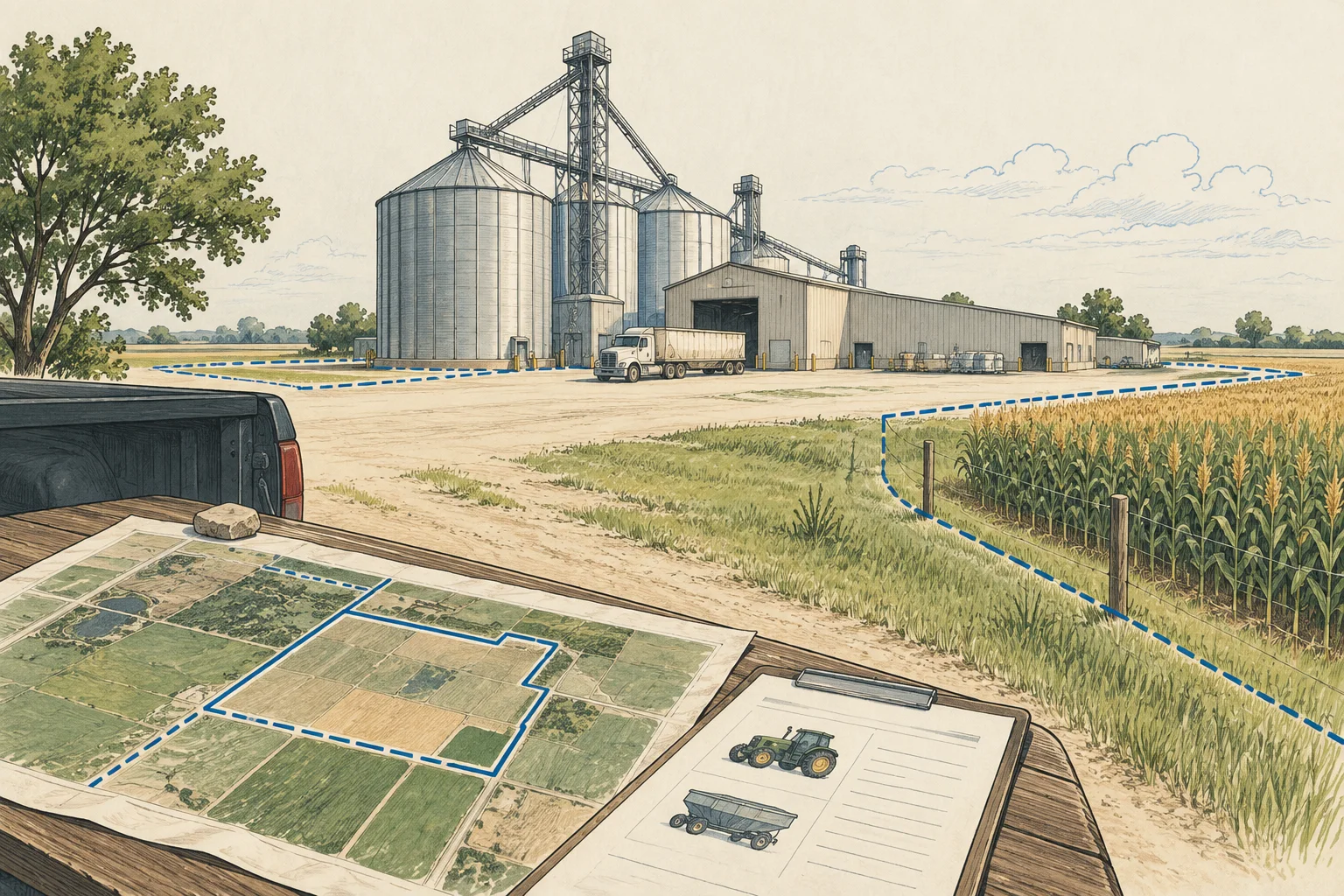
Nebraska / Grain-facility records

Nebraska grain facilities: separate licensed capacity and property

For a Nebraska grain or agricultural-service acquisition, define what is being bought before comparing capacity. Land, bins, handling equipment, stored grain and the operating business can sit in the same sales narrative. Build a location-level reconciliation that separates the licensed operation from the included real estate, then identify which capacity depends on assets or arrangements outside the proposed transaction.

This guide uses Nebraska PSC public resource descriptions. It does not establish any facility’s capacity, licensing status, inventory or transferable rights.

Conceptual illustration of documents and decisions for Nebraska commercial property research

What changes the decision

Nebraska grain facilities: distinguish the licensed operation from the real estate

01

Start with the correct regulatory record

The Nebraska Public Service Commission’s grain page distinguishes grain-warehouse and grain-dealer regulation and links license information and a Location Capacity Report. Those are useful research entry points with different purposes. For the acquisition file, record which list or report you used and its date before carrying a facility description into a real-estate comparison.

Source 1
02

Capacity is not a building-area conversion

Make a schedule of the storage structures represented in the offering, with a reference for each capacity figure. Ask which structures are owned, leased, unavailable or excluded. Do not convert a parcel’s improvement area into storage capacity or assume the operator’s reported capacity belongs entirely to the seller’s land.

03

Temporary arrangements deserve a separate line

PSC publishes an emergency ground-storage application path. Its existence is a reason to ask whether an operating description includes temporary arrangements, not evidence that a particular site has permission. Isolate seasonal storage, off-site contracts and equipment dependencies so the acquisition case does not treat them as permanent owned improvements.

Source 1

Read the records together

Evidence and its investment use

EvidenceWhat it establishesNext decision
Warehouse or dealer recordA regulatory identity and record type to investigate.Identify the operator and exact location being discussed.
Location capacity materialA capacity statement with a date and reporting scope.Reconcile the included structures and operating arrangements.
Purchase asset scheduleWhat the proposed transaction says is included.Resolve excluded equipment, leased facilities and business assets.
Conceptual illustration of the Nebraska research workflow

Put it to work

Grain facility asset reconciliation

The worksheet produces an asset-and-capacity reconciliation. It is designed for the buyer who needs to decide which statements can support a property comparison and which belong in operating-business diligence.

  1. Identify the operator and location

    Capture the operator name, facility location and relevant PSC resource. Keep a stable internal location label when a business runs multiple sites. Preserve the source date and record type so a dealer listing is not presented as proof of a specific warehouse’s physical capacity.

    Source 1
  2. Create the physical asset schedule

    Request a plan showing bins, buildings, scales, conveyors and access areas. For each component, record whether it is included, owned by another party or leased. Ask the seller to resolve components referenced in the capacity schedule but absent from the purchase exhibit.

  3. Reconcile operational dependencies

    Request the basis of the stated storage capacity, including unavailable space and any temporary or remote arrangements. Record handling equipment and third-party access needed to use that capacity. Have the operating specialist assess those dependencies instead of assuming every nominal storage component works as a single system.

  4. Prepare separate property and business questions

    Give the real-estate reviewer the boundary, structures and access issues. Give the operating-business reviewer the licensing, inventory and performance questions. Export the unresolved-items sheet with a named reviewer role for each issue, and keep unverified capacity out of any comparative acquisition ranking.

Before the next conversation

Questions this review should answer

Can I rank facilities directly from a capacity report?

Use a report to identify questions and candidate locations. A comparison needs consistent treatment of included structures, leased storage and unavailable capacity. Retain the original figure and its source while building a separate reconciled figure only when the supporting documents actually justify it.

Does a warehouse license identify everything included in a sale?

No purchase-scope conclusion follows from the regulatory identity alone. The asset schedule, leases and transaction documents need their own review. The most useful discrepancy is often a component that supports the operating narrative but does not appear in the property or equipment exhibits.

How could an AI workflow help this niche?

AI can compare the offering, plans and asset schedule, highlight unmatched structure labels and preserve capacity references by location. Ask it to create questions rather than estimate missing bushels. A human reviewer should approve every reconciliation that changes the physical or financial acquisition scope.

From the page to your next task

Start with the useful output.

Grain-location-to-asset reconciliation

Build an editable grain-location-to-asset reconciliation, retain document references and open decisions, then export your team's working file.

Scope: Grain facility

Bring
A working file name; use a non-sensitive label for your project. Your document references and observations, or leave missing evidence marked unknown.
Leave with
Grain-location-to-asset reconciliation with editable, expandable records and document locators Two fictional worked rows showing mismatches and decisions to review CSV and readable text exports with row provenance, method sources and edition A separate document-request companion with suggested reviewers

Edition 2026-09-30.1

Evidence and scope

Follow each claim to its source.

Grain

Nebraska Public Service Commission · Checked 2026-09-30

Grain regulatory resource page, license paths, Location Capacity Report and emergency ground-storage application.

  • No individual facility record or capacity total was extracted; state and federal regulatory scopes require facility-specific review.
Open original source ↗