

Missouri / Storage expansion evidence

Missouri self-storage expansion: separate units from acreage

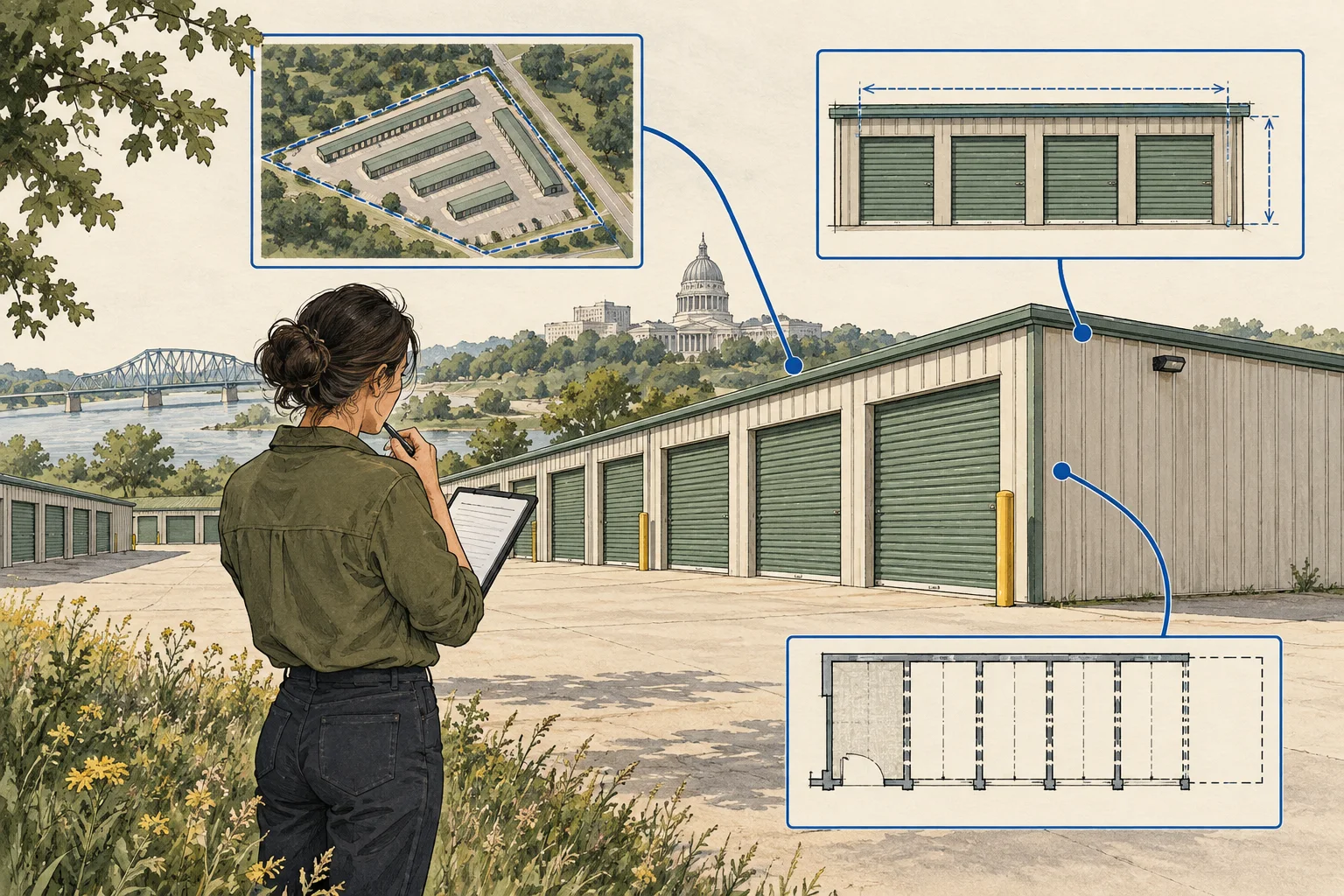
For a Missouri storage acquisition, build the current unit schedule before assigning value to the extra land. A parcel can contain operating buildings, circulation, drainage and a proposed addition at the same time. The useful sourcing question is which income exists today and which expansion still depends on a defined construction scope. Keep those two cases visible in the investment memo.

Editorial acquisition method using Missouri DNR construction guidance. No facility inventory, measured unit count or property-specific permit determination is supplied.

Conceptual illustration of documents and decisions for Missouri commercial property research

What changes the decision

Missouri self-storage: separate rentable units from expansion acreage

01

The disturbance boundary may exceed the next building footprint

Missouri DNR describes construction land disturbance broadly and applies its permit threshold to qualifying common plans as well as individual sites. For an expansion screen, ask the civil engineer to draw the entire proposed disturbance area, including access and drainage work. A sketch of new storage buildings alone is an incomplete basis for the permitting conversation.

Source 1
02

Unit inventory needs its own denominator

Reconcile the unit-level rent roll to a dated site plan. Separate enclosed storage, outdoor spaces, manager areas and units out of service. Record why each category is included in rentable capacity. This gives the buyer a clean question to ask about an apparent vacancy gap rather than treating every labelled rectangle as an available revenue unit.

03

Expansion belongs in a separate decision file

Build an expansion register with a concept layout, local use review, utility assumptions and construction responsibilities. Keep gross land area out of the existing-income denominator. If the seller prices unbuilt capacity into the deal, identify the evidence that would convert that capacity from a concept into a supportable underwriting scenario and who can supply it.

Read the records together

Evidence and its investment use

EvidenceWhat it establishesNext decision
Dated unit scheduleUnits represented as rentable and their recorded status.Reconcile excluded or combined spaces before comparing occupancy.
Disturbance planProposed ground work, including work beyond buildings.Ask the engineer to assess the complete project scope.
Expansion conceptA proposed future layout with explicit assumptions.Keep unbuilt income separate until design and permissions are resolved.
Conceptual illustration of the Missouri research workflow

Put it to work

Storage inventory and expansion split

Use the worksheet to bring the operating record and expansion story into one review. The objective is a defensible current inventory plus a short list of decisions that control additional capacity.

  1. Freeze the operating snapshot

    Choose a rent-roll date and retain the corresponding site plan. Assign each space a stable internal label, type and service status. Log discrepancies such as two spaces combined into one lease. Have the manager confirm changes instead of silently correcting the seller file.

  2. Draw the expansion question

    Mark the proposed new buildings, construction access, drainage work and any work shared with adjacent phases. Record which drawing supplied each boundary. Ask the project engineer to evaluate the common-plan question against DNR guidance and document the conclusion for this proposal.

    Source 1
  3. Separate permissions from design

    Request the existing approvals and ask the local planning office which proposed changes require review. Send the same concept to the engineer and utility provider. Maintain separate entries for an approval, an application and a design assumption so an early discussion does not become an entitlement claim.

  4. Write the acquisition handoff

    Summarize the reconciled operating inventory, the proposed additions and the unresolved dependencies. Assign a responsible reviewer to each gap. Use the kit to export the request sheet for the acquisition team, with expansion income explicitly conditional on the listed evidence.

Before the next conversation

Questions this review should answer

Can parcel building area establish the unit mix?

Use it as a cross-check, not the unit schedule. Corridors, office space, exterior storage and unavailable units need different treatment. Ask for the management-system export and an annotated floor or site plan, then preserve the reconciliation so a later count change does not silently alter occupancy.

Does a small first phase settle the disturbance question?

No conclusion follows from a phase label alone. The DNR guidance makes the broader common plan relevant. Give the engineer the complete intended build-out and related ground work, including work performed by others, rather than requesting an opinion on a cropped drawing.

Source 1
Where can AI help without guessing expansion value?

AI can group inconsistent unit descriptions, flag missing statuses and draft requests tied to conflicting records. It should retain the original labels and references. The acquisition team still chooses the operating denominator, and the qualified project reviewers decide whether the expansion assumptions are supportable.

From the page to your next task

Start with the useful output.

Operating-storage versus expansion register

Build an editable operating-storage versus expansion register, retain document references and open decisions, then export your team's working file.

Scope: Storage expansion

Bring
A working file name; use a non-sensitive label for your project. Your document references and observations, or leave missing evidence marked unknown.
Leave with
Operating-storage versus expansion register with editable, expandable records and document locators Two fictional worked rows showing mismatches and decisions to review CSV and readable text exports with row provenance, method sources and edition A separate document-request companion with suggested reviewers

Edition 2026-09-30.1

Evidence and scope

Follow each claim to its source.

Construction Land Disturbance Permits

Missouri Department of Natural Resources · Checked 2026-09-30

Construction land-disturbance guidance and common-plan concept in Missouri.

  • Does not establish local zoning, storage-unit counts or the permit obligations of any particular project.
Open original source ↗