

Massachusetts / Boston laboratory example

Boston laboratory reuse: check the intended research activity

A life-science building should be matched to a specific tenant activity before it is described as ready. Use a Boston example to separate the building file, laboratory registration and relevant public-health pathway. Then ask the engineering and operating reviewers what the proposed work requires. The result is a tenant-specific evidence brief, not a generic label attached to an office building.

Boston official sources checked September 30, 2026 as a bounded Massachusetts example. Other municipalities and research activities need their own authority and technical review.

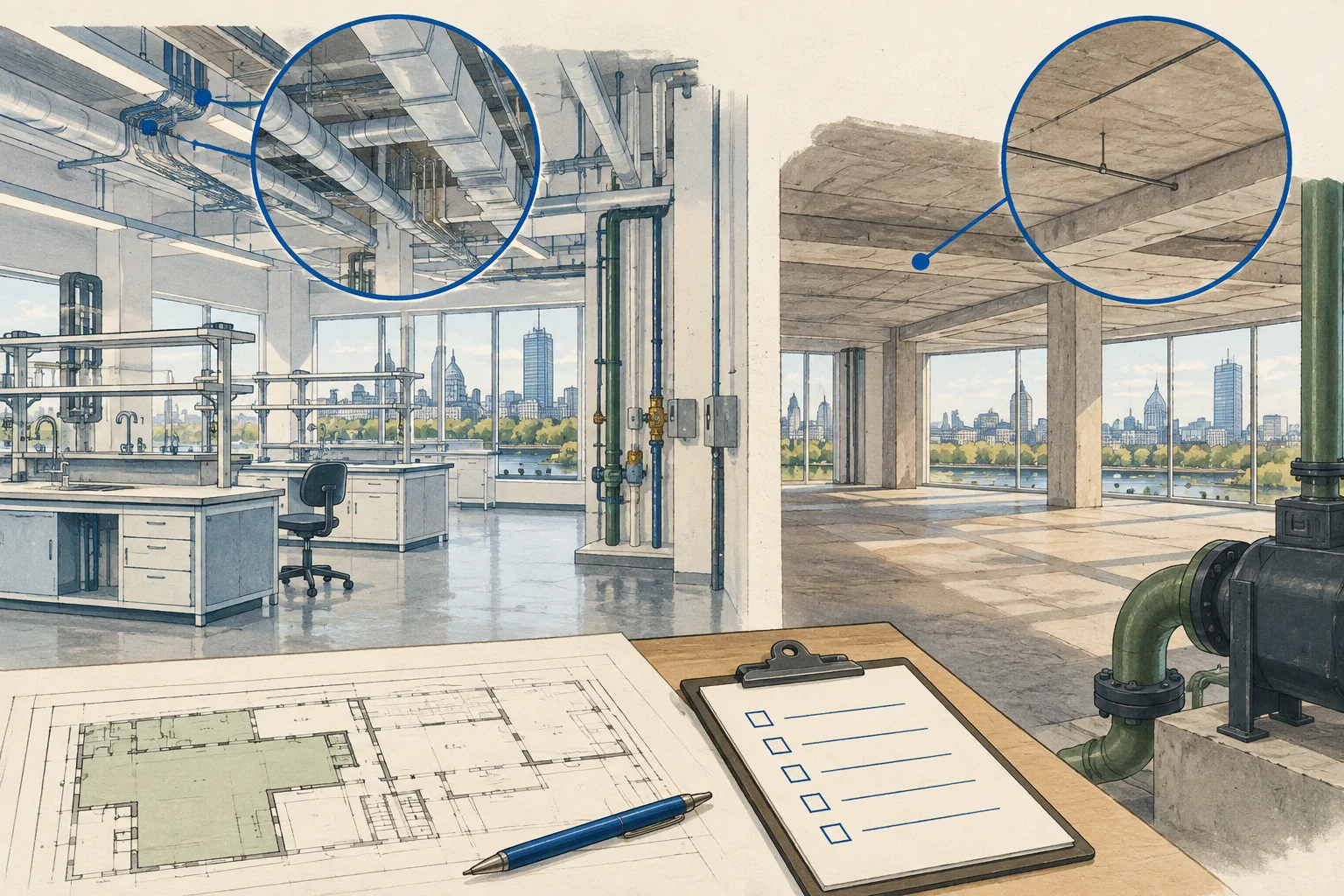
Conceptual evidence illustration for Massachusetts: laboratory activity and building fit. No surveyed geography or real property depicted.

Start with the right evidence

What changes the decision

01

Laboratory activity is part of the question

Boston Fire Prevention directs laboratory registration through its Lab Safety unit and describes the activities within its guidance. Write down the proposed processes and materials before routing a request. A life-sciences marketing category is less useful to a reviewer than a clear description of what the occupier plans to do.

Source 1
02

Public-health review is a separate path

Boston Public Health Commission lists a biological-safety permitting path for the activities it describes. Keep that question separate from building permits and general registration. Ask the relevant specialist to determine which path applies rather than assuming every laboratory has the same requirements or that one document answers them all.

Source 1
03

Building capability needs technical evidence

Request the schedules and condition information for the services the proposed tenant actually needs, such as ventilation, power or specialist systems. Ask the engineer to identify required tests and design work. The guide does not infer capability from the building’s name, a lab bench photograph or an earlier tenant’s operations.

Different records, different questions

Keep these decisions separate

EvidenceUseful questionNext document
Building fileWhat premises and physical work do the documents describe?Relevant building and occupancy records, plans and system schedules.Source 1
Lab registrationHow is the proposed activity routed for local safety review?Actual registration documents or a scoped inquiry to the responsible unit.Source 1
Biological activityDoes the proposed work require the separate agency pathway?Activity description and specialist review of the relevant public-health documents.Source 1
Conceptual Massachusetts research sequence, not a factual map or property inspection.

An acquisition desk workflow

Build a reviewable file

Use these steps as an editorial research method. The worksheet records what your documents support and assigns a next action to what remains unresolved.

  1. Write the tenant’s activity brief

    Ask the prospective occupier to describe processes, materials, equipment and operating needs at an appropriate nonconfidential level. Separate confirmed requirements from optional future expansion. This creates the basis for document requests without exposing proprietary research or pretending that a broad life-science label describes the actual operation.

  2. Locate the local document paths

    For a Boston asset, distinguish Inspectional Services, Fire Prevention’s laboratory registration and the relevant Public Health Commission pathway. Record which question goes to each. For another Massachusetts municipality, identify its actual authorities rather than transplanting Boston’s process or assuming the same form applies statewide.

    Source 1Source 2Source 3
  3. Match systems to requirements

    Give the engineer the activity brief and supplied building schedules. Ask for a gap list covering documented capability, unknown condition and proposed work. Keep design assumptions and commissioning evidence separate; the presence of equipment in a schedule should not be described as proof that it currently performs to the tenant’s needs.

  4. Export the readiness questions

    The worksheet records the activity brief, building evidence, registration path and relevant specialist review. Assign each gap to the occupier, engineer or permit adviser. Download text or CSV to guide the next discussion, with a clearly labelled fictional example and no automated readiness score, permit conclusion or predicted fit-out cost.

Before the next request

Questions worth resolving

Does a previous laboratory tenant prove the next tenant can move in?

No. Compare the next tenant’s actual requirements with the building evidence and relevant operating paths. A prior use can help identify documents to request, but it should not replace a review of current systems, proposed activity and the local process applicable to the next operation.

Do Boston’s laboratory pathways apply everywhere in Massachusetts?

No. They are the specific local example used here. Other municipalities and activities need their own record and authority checks. Keep the location and proposed activity in the file, and ask a local adviser to route the questions rather than presenting Boston guidance as a statewide permission statement.

Source 1Source 2Source 3
How can AI help evaluate a Massachusetts lab-space file?

Ask it to cross-reference the tenant activity brief, system schedules and the three Boston document paths: building records, lab registration and biological-safety review where relevant. It can flag an uncited capability or missing activity description. The engineer and appropriate regulatory advisers decide technical fit and the actual approval requirements.

Source 1Source 2Source 3

From the page to your next task

Start with the useful output.

Lab-activity and system requirement bridge

Build an editable lab-activity and system requirement bridge, retain document references and open decisions, then export your team's working file.

Scope: Boston official sources checked September 30, 2026 as a bounded Massachusetts example. Other municipalities and research activities need their own authority and technical review.

Bring
Your case name Document status, observations and references for each evidence row
Leave with
Lab-activity and system requirement bridge with editable, expandable records and document locators Two fictional worked rows showing mismatches and decisions to review CSV and readable text exports with row provenance, method sources and edition A separate document-request companion with suggested reviewers

Edition 2026-09-30.1

Evidence and scope

Follow each claim to its source.

Laboratory Registration

City of Boston Fire Prevention · Checked 2026-09-30

Laboratory registration pathway and Lab Safety unit guidance.

  • Boston-specific guidance is not a statewide laboratory permission or confirmation of a building capability.
Open original source ↗
Public Health Permits

Boston Public Health Commission · Checked 2026-09-30

Biological-safety permit pathway for the laboratory activities described by the agency.

  • Program applicability and a particular operation require review; a property label does not establish a permit.
Open original source ↗
Inspectional Services

City of Boston Inspectional Services · Checked 2026-09-30

Local building, permit and inspection service entry point.

  • The service directory does not establish occupancy, system condition or the suitability of a laboratory space.
Open original source ↗