

Idaho / Project-specific service

Idaho development land: turn nearby utilities into a service question

For Idaho development land, replace the phrase utilities nearby with a documented connection scenario. Identify the proposed activity, the provider and the works the project may require. DEQ’s public-water-system resources help route regulatory and technical questions, while the provider’s response and the engineer’s design establish the project-specific work that still needs review.

Idaho DEQ water-system resources checked September 30, 2026. The workflow does not establish a parcel’s service eligibility, system capacity or development entitlement.

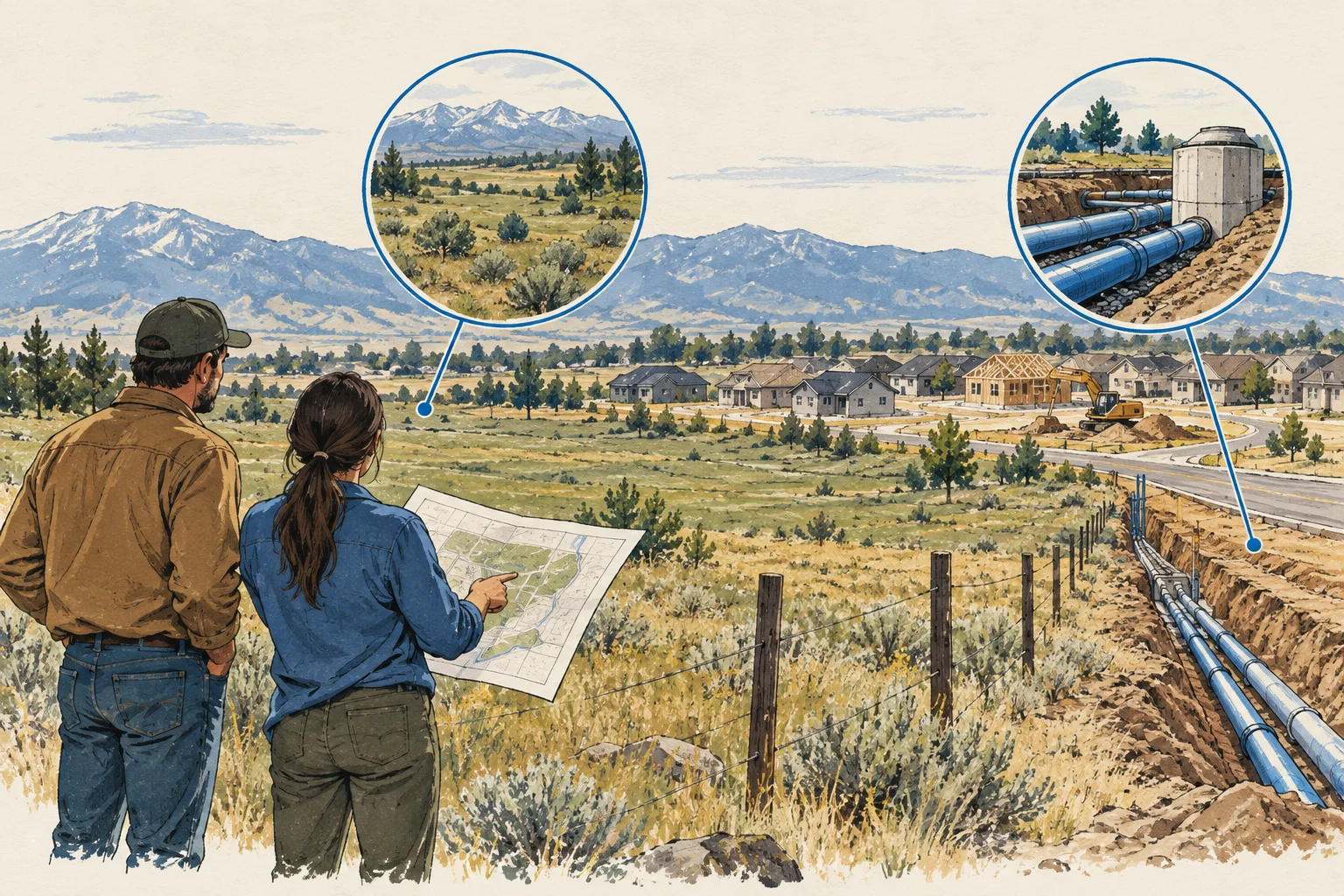
Conceptual evidence illustration for Idaho: utility connection and extension. No surveyed geography or real property depicted.

Start with the right evidence

What changes the decision

01

System records and service commitments differ

DEQ’s switchboard links public-water-system subjects such as plans and specifications, sanitary surveys and capacity development. Those are useful paths for understanding the system and review process. They do not reserve capacity for a buyer’s project or define the commercial terms of a new connection.

Source 1
02

An extension needs a described scope

Ask the engineer to identify the proposed connection point, route, physical works and dependencies. Keep these as a concept until the relevant parties review them. A nearby line can prompt an inquiry, but distance alone should not supply a construction cost, delivery date or statement of available capacity.

03

Water is not the whole utility plan

Create separate requests for wastewater, power and other services material to the intended activity. Use the same project brief for each provider. This avoids combining unrelated informal statements into one ready-to-build label when each service may have different documentation, timing and work requirements.

Different records, different questions

Keep these decisions separate

EvidenceUseful questionNext document
Regulated system informationWhich system and technical review path are relevant?System identity and the appropriate underlying DEQ or provider records.Source 1
Provider responseWhat has the provider actually agreed to evaluate or provide?Written response to the defined location and demand, including unresolved conditions.
Extension conceptWhat infrastructure work does the project assume?Engineer-prepared route, scope and dependency schedule for review.
Conceptual Idaho research sequence, not a factual map or property inspection.

An acquisition desk workflow

Build a reviewable file

Use these steps as an editorial research method. The worksheet records what your documents support and assigns a next action to what remains unresolved.

  1. Write a service brief

    Describe the intended use, initial scale and expansion assumptions without inventing engineering demand. Ask the appropriate designer to specify the information each provider needs. Give water, wastewater and power reviewers a consistent version of the project so their responses can be compared without silently changing the scenario.

  2. Identify the public-water-system path

    Use DEQ’s switchboard to locate the relevant technical resources and regional contacts. Record which question belongs to system records, which belongs to plans review and which needs a provider commitment. Ask for the documents appropriate to the actual proposal rather than downloading unrelated program material as apparent diligence.

    Source 1
  3. Request a written connection scenario

    Ask the provider to respond to the intended location and demand, explaining what remains subject to study, construction or agreement. Have the engineer describe the assumed extension and connection works. Retain the response date and conditions so a preliminary discussion is not later quoted as an unconditional service promise.

  4. Build the infrastructure decision list

    Use the worksheet to connect each missing item to its consequence for the acquisition: timing, design, off-site work or uncertain cost. Name the provider coordinator and technical reviewer. Export those tasks for the development meeting, keeping unknowns visible instead of filling an unsupported construction allowance from nearby-line distance.

Before the next request

Questions worth resolving

Does a DEQ public-water-system record prove the site can connect?

No. It helps identify the system and relevant technical information. A project connection requires its own provider response and review of the proposed works. Keep regulatory records, physical design and commercial service terms in separate rows so the source is used for the question it can actually answer.

Source 1
Can a nearby utility line be used to estimate extension cost?

Use it to frame the initial question, not as a substitute for a reviewed scope. Ask the engineer and provider what works, crossings, equipment and approvals the proposal may involve. A cost assumption should identify the estimate and scope behind it, rather than inherit a map distance.

How can AI improve an Idaho utility-connection review?

Ask AI to map the supplied provider response to the project demand brief, DEQ system-reference documents and engineer’s extension concept. Have it distinguish a commitment from a request for further study, and flag inconsistent project versions. The provider coordinator resolves service terms; the engineer reviews capacity evidence, connection works and missing technical information.

Source 1

From the page to your next task

Start with the useful output.

System-to-connection work register

Build an editable system-to-connection work register, retain document references and open decisions, then export your team's working file.

Scope: Idaho DEQ water-system resources checked September 30, 2026. The workflow does not establish a parcel’s service eligibility, system capacity or development entitlement.

Bring
Your case name Document status, observations and references for each evidence row
Leave with
System-to-connection work register with editable, expandable records and document locators Two fictional worked rows showing mismatches and decisions to review CSV and readable text exports with row provenance, method sources and edition A separate document-request companion with suggested reviewers

Edition 2026-09-30.1

Evidence and scope

Follow each claim to its source.

Public Water System Switchboard

Idaho Department of Environmental Quality · Checked 2026-09-30

Public-water-system resources including plans, specifications, surveys and capacity-development pathways.

  • Program information does not establish service capacity, extension approval or a commitment to a particular parcel.
Open original source ↗