

Georgia / Road-to-site access

Georgia warehouse access: investigate the last mile

A site near an interstate is not automatically a workable freight location. For a Georgia logistics or outdoor-storage acquisition, test the proposed movement from the highway to the loading area. Keep route restrictions, driveway evidence and on-site circulation separate. The result is a practical access file that can explain why a promising location still needs a document or engineering decision.

Georgia transportation guidance checked September 30, 2026. The guide does not approve a route, vehicle movement or site entrance.

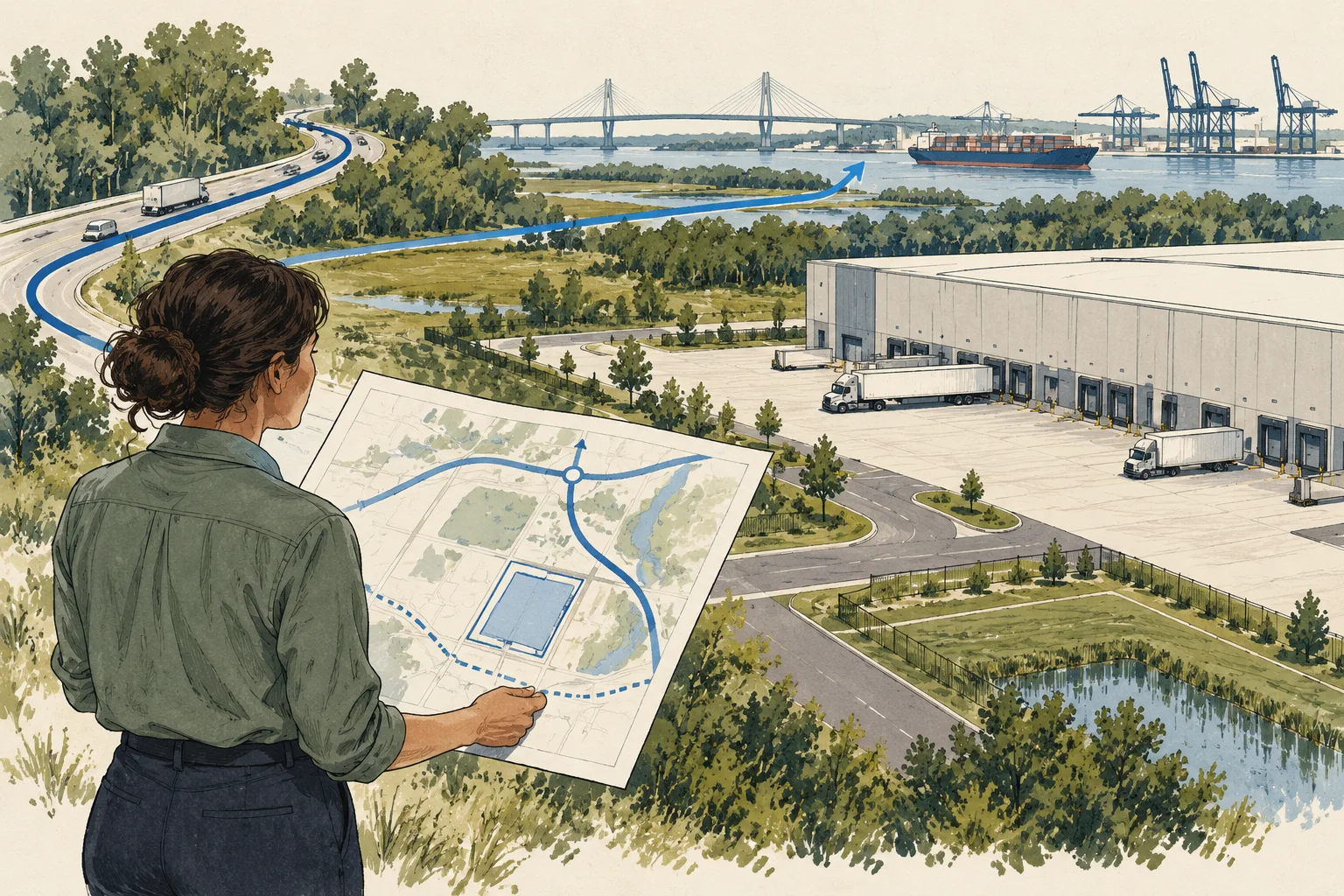
Conceptual evidence illustration for Georgia: freight route and site entrance. No surveyed geography or real property depicted.

Start with the right evidence

What changes the decision

01

Highway routing and driveway review use different paths

GDOT’s access-management resources include the GPAS driveway and encroachment pathway. Its oversize resources point to routing and permitting tools including GAPROS. These answer different questions. Record whether a document concerns the public-road movement or the connection into the property before treating it as access evidence.

Source 1Source 2
02

The vehicle defines the test

Write down the intended truck or equipment configuration, loading pattern and operating schedule. A generic logistics description is too broad for a route review. Ask the transport specialist which restrictions and turning conditions matter for that movement, without assuming that another occupier’s deliveries prove the proposed operation will work.

03

On-site circulation needs its own drawing

Request a current site plan showing the entrance, maneuvering area, loading positions and any shared circulation. Ask the engineer to test the actual movement. Road frontage, a gate visible in imagery and a broker’s drive-time estimate do not establish the geometry or legal control of the route inside the property.

Different records, different questions

Keep these decisions separate

EvidenceUseful questionNext document
Public-road routeCan the intended movement use the proposed route under relevant conditions?Route review and any movement-specific authorization identified by the transport specialist.Source 1
Property entranceWhat supports the connection from the road into the site?Driveway or encroachment record and the applicable approved plan.Source 1
Private circulationCan the vehicle reach and use the loading area?Current layout, swept-path review and any shared-access agreement.
Conceptual Georgia research sequence, not a factual map or property inspection.

An acquisition desk workflow

Build a reviewable file

Use these steps as an editorial research method. The worksheet records what your documents support and assigns a next action to what remains unresolved.

  1. Write a movement brief

    Define origin and destination, vehicle dimensions or configuration, delivery frequency and operating hours. Separate ordinary deliveries from exceptional movements that may need additional review. Give this brief to both the carrier or transport adviser and the site engineer so their answers test the same operating scenario.

  2. Review the public-road segment

    Use GDOT’s oversize and routing resources to identify the appropriate review path when relevant to the intended movement. Keep the route, date and conditions with the result. Do not generalize a route response for one movement into an unrestricted access claim for all future tenants or vehicles.

    Source 1
  3. Locate the entrance evidence

    Use the access-management pathway to identify the applicable driveway or encroachment records and responsible office. Request the actual record and plan for the entrance in question. If the offered site uses a shared approach, flag that relationship separately for title and operating review rather than assuming frontage solves it.

    Source 1
  4. Reconcile the gate-to-dock movement

    Have the engineer compare the site layout with the vehicle brief and identify missing measurements or conflicts. Use the worksheet to assign route, entrance, circulation and private-access requests. Export the unresolved items before incorporating the location into a tenant fit assessment or describing the yard as ready for use.

Before the next request

Questions worth resolving

Does interstate proximity make a Georgia site suitable for logistics?

It is a location characteristic, not an access conclusion. Test the actual route, entrance and internal movement for the intended vehicles. The method helps explain which part is supported by documents and which needs transport, engineering or title review, without turning a distance into an operating approval.

Are GPAS and GAPROS interchangeable evidence?

No. The cited agency pages route driveway or encroachment matters and oversize routing matters differently. Keep the system, document type and movement or entrance scope in the file. A record from one path should not be used as proof that the other question has been resolved.

Source 1Source 2
How can AI help test a Georgia logistics site?

Have AI organize the supplied GPAS-related entrance record, GAPROS-related route evidence and site plan against one vehicle brief. Ask it to flag a route response for a different movement or an entrance without a referenced plan. The transport specialist reviews the public route, the engineer tests circulation, and counsel addresses private-access rights.

Source 1Source 2

From the page to your next task

Start with the useful output.

Freight-route-to-entrance register

Build an editable freight-route-to-entrance register, retain document references and open decisions, then export your team's working file.

Scope: Georgia transportation guidance checked September 30, 2026. The guide does not approve a route, vehicle movement or site entrance.

Bring
Your case name Document status, observations and references for each evidence row
Leave with
Freight-route-to-entrance register with editable, expandable records and document locators Two fictional worked rows showing mismatches and decisions to review CSV and readable text exports with row provenance, method sources and edition A separate document-request companion with suggested reviewers

Edition 2026-09-30.1

Evidence and scope

Follow each claim to its source.

Access Management

Georgia Department of Transportation · Checked 2026-09-30

Driveway and encroachment permit pathways including GPAS.

  • A permit pathway does not establish approval, physical capacity or private access for a site.
Open original source ↗
Oversize Permits

Georgia Department of Transportation · Checked 2026-09-30

Official routing and oversize-permit resources, including GAPROS and responsible contacts.

  • Route information is movement-specific and does not establish a site’s entrance or private access rights.
Open original source ↗