

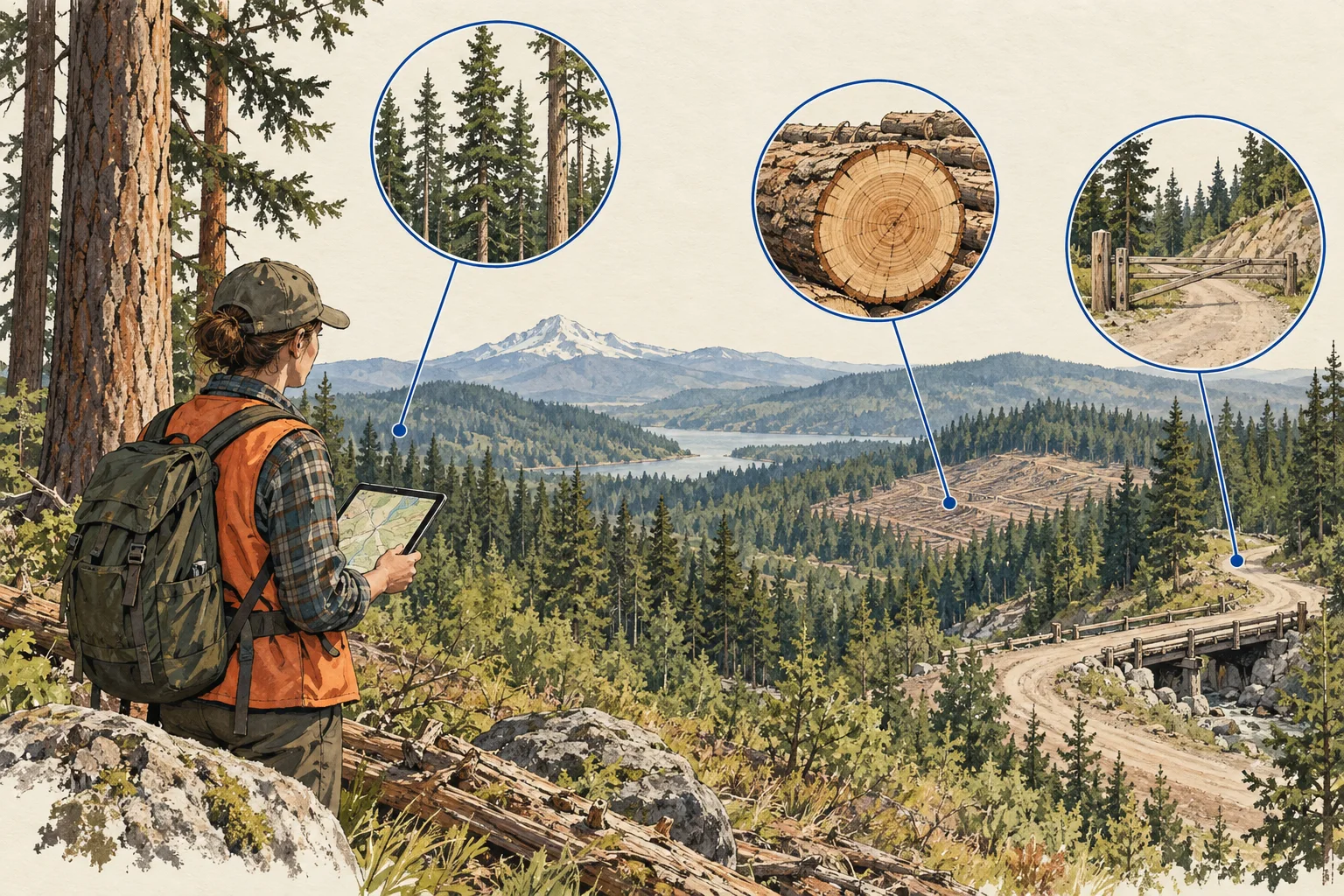
Stand inventory and access

Timberland review: connect stand inventory and harvest rights

Timberland research should separate land ownership, standing-timber evidence and the ability to access and harvest it. Regional forest statistics cannot substitute for a tract-specific inventory. AI can organize stand maps, cruise records, access documents and management history, helping a forester and counsel identify the next review questions without inventing merchantable volume or a future harvest value.

NextAutomation editorial research method. Public sources establish the framework; the worksheet example is fictional and no property has been verified.

Conceptual illustration of timber stands, cruise dates, access and harvest obligations

What changes the decision

Read the operating model before the headline

01

Regional inventory is not a tract cruise

The Forest Service’s FIA program is a sample-based national forest inventory and analysis program. Its context can inform research, but it does not establish the species, volume or condition on a particular tract. Ask for the property-specific inventory, method and date. Preserve the difference between regional estimates and observations made for the actual land under review.

Source 1
02

The stand is the useful operating unit

Species mix, age, management history and access can vary within a tract. Connect stand IDs to maps and the inventory used by the forester. A single acres-and-volume headline hides both variation and uncertainty. Keep harvested, recently planted and unmanaged areas separate rather than applying one stocking or growth assumption to every acre.

03

Ownership and harvestability are distinct

Land title may not alone establish timber ownership, road access or the conditions for harvesting. Request relevant deeds, timber reservations, contracts, easements and management restrictions. Keep physical access and legal access separate. A visible logging road does not establish a current right to use it, and an old harvest does not prove that the same operation is permitted now.

Keep these separate

Three distinctions to preserve in the file

Evidence or situationWhat it tells youWhat to establish next
Regional forest statisticDescribes a broader sampled populationUse as context only; obtain a tract-specific inventory for the subject property.
Timber cruiseEstimates a defined resource using a stated methodReview date, sampling scope, stand mapping and subsequent harvest or disturbance.
Harvest opportunityCombines resource, rights and operating conditionsEstablish access, restrictions, sale terms and qualified forestry review before forecasting proceeds.
Conceptual illustration of timber stands, cruise dates, access and harvest obligations

A practical review sequence

Build a file another reviewer can follow

Use the sequence below to turn the initial description into specific document requests. Preserve contradictory records instead of choosing the more favorable version.

  1. Map tract and stand identities

    Request boundary information, stand maps and the current management plan. Align stand names used in inventory files with the mapped areas. Flag timber rights or parcels that are excluded from the transaction. AI can help connect identifiers, but uncertain boundaries should remain questions for the surveyor and forester.

  2. Review the inventory basis

    Collect cruise reports, measurement dates, sampling methods and available species or product classifications. Ask the forester to explain uncertainty and whether intervening growth, harvest, fire or other disturbance changes the relevance of the record. Do not update historic volume with an assumed growth rate and label it a new inventory.

  3. Trace access and operating constraints

    Obtain road agreements, easements, timber reservations and relevant management restrictions. Record seasonal or maintenance conditions where documented. Ask local specialists which additional approvals or operating practices apply. A desk map should guide questions, not certify that equipment can reach every stand or that a harvest can proceed.

  4. Prepare the forestry handoff

    Combine inventory gaps, access questions and contract issues into a stand-specific task list. Keep a proposed harvest separate from an executed timber sale and actual proceeds. The kit supports document organization and reviewer coordination; it does not appraise timber, predict commodity prices or calculate a sustainable harvest schedule.

Questions that arise during review

Resolve the ambiguity before the model

Can AI estimate timber volume from acreage?

Not defensibly through this kit. Acreage alone omits stocking, species, age and condition. Use a qualified forester’s tract-specific evidence and preserve its date and uncertainty. AI can organize that evidence but should not fabricate missing stand volumes.

Does the national inventory identify my tract?

The cited FIA program provides broader forest information through its sampling and analysis framework. It should not be presented as a substitute for the subject property’s cruise. Keep regional context separate from the record supporting an actual tract decision.

What should AI check across forestry documents?

Ask it to match stand IDs, inventory dates, harvest records and access references, then flag stands whose inventory predates a documented disturbance. Have a forester assess the resource implications and counsel review rights. A mismatch creates a review task, not an automatic revised volume.

From the page to your next task

Start with the useful output.

Stand, inventory and access register

Build an editable stand, inventory and access register, retain document references and open decisions, then export your team's working file.

Scope: timber stands, cruise dates, access and harvest obligations

Bring
An optional file nickname Status, observations and document references for the four evidence items; unknown is acceptable
Leave with
Stand, inventory and access register with editable, expandable records and document locators Two fictional worked rows showing mismatches and decisions to review CSV and readable text exports with row provenance, method sources and edition A separate document-request companion with suggested reviewers

Edition 2026-09-30.1

Evidence and scope

Follow each claim to its source.

Commercial Real Estate Lending, Comptroller’s Handbook, version 2.0

Office of the Comptroller of the Currency · Checked 2026-09-30

March 2022 supervisory handbook; lease review, property income, re-leasing costs and property-type distinctions.

  • Bank supervisory guidance, not a property appraisal, current market survey or universal financing standard. No handbook percentage is adopted as a deal assumption.
Open original source ↗
Forest Inventory and Analysis

USDA Forest Service · Checked 2026-09-30

Sample-based national forest inventory and analysis program.

  • Regional estimates are not a tract-specific timber cruise, merchantable volume certification, harvest approval or timber ownership record.
Open original source ↗