

Stall use and operating agreements

Parking acquisition review: reconcile stalls, time and receipts

Parking research should establish which spaces are controlled, when they are available and how the operator converts use into owner receipts. A stall count alone cannot describe hourly turnover, monthly commitments or an operating concession. AI can organize inventory, agreements and revenue records while keeping physical capacity separate from rights, accessibility and the accounting basis of each payment.

NextAutomation editorial research method. Public sources establish the framework; the worksheet example is fictional and no property has been verified.

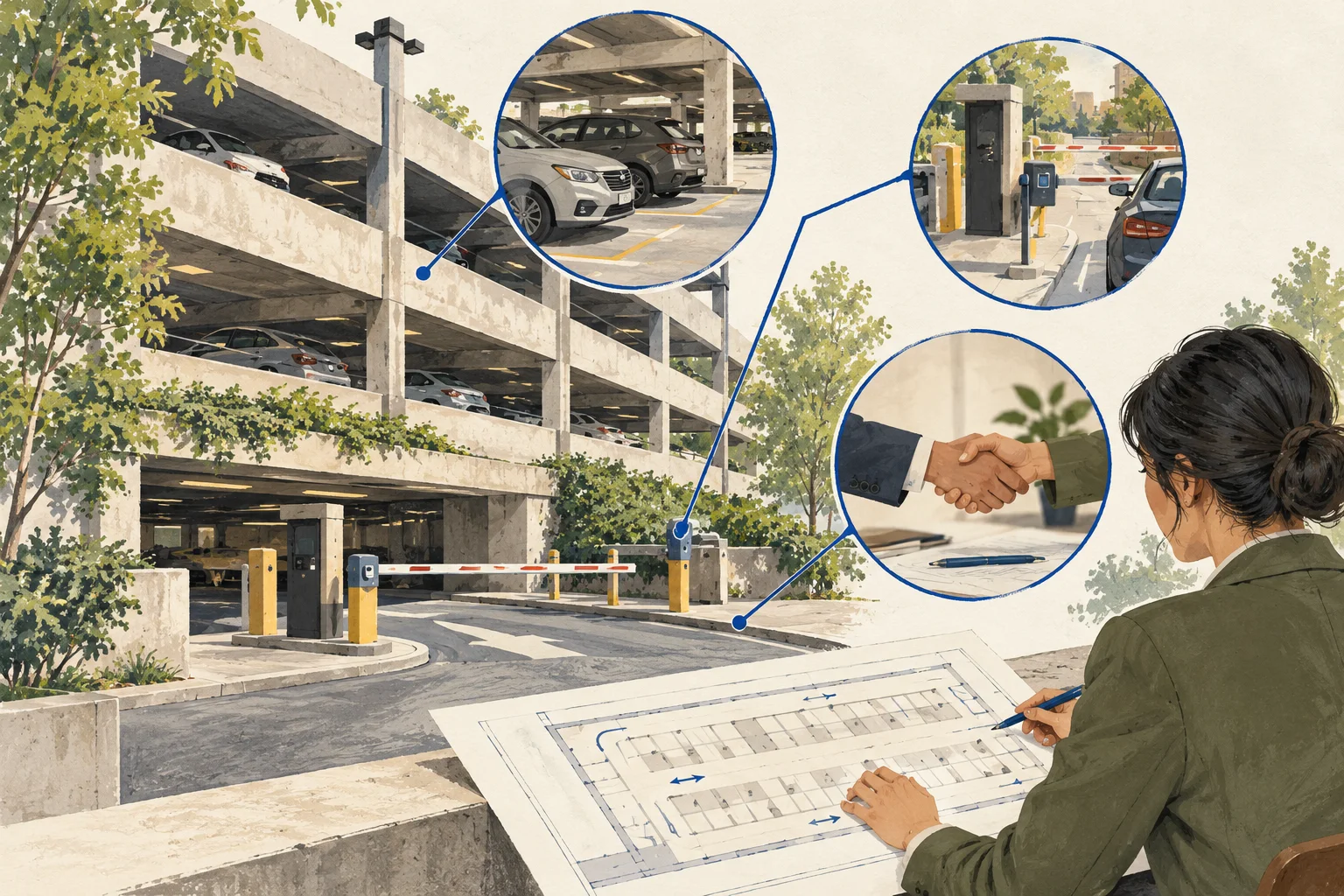
Conceptual illustration of parking-space inventory, time rights and operator revenue

What changes the decision

Read the operating model before the headline

01

Access aisles are not spare stalls

DOJ’s parking guidance addresses accessible spaces, access aisles and accessible routes. Use that framework to request an appropriate site review rather than counting every painted or paved area as revenue inventory. Keep circulation and accessibility features visible on the plan. This worksheet does not certify compliance or replace measurements and qualified interpretation of applicable requirements.

Source 1
02

The same space has a time dimension

Monthly agreements, event reservations, shared-use arrangements and hourly operations may claim the same physical inventory at different times. Record the rights and time windows before adding capacities. A space reserved to an office tenant during business hours should not automatically be treated as unrestricted inventory in an all-day revenue assumption.

03

Operator sales and owner income differ

A management agreement, lease or concession can produce different owner receipts from the same customer activity. Preserve gross sales, taxes, refunds, operator fees and amounts remitted separately. AI can build the accounting bridge, but a high payment-terminal total is not automatically the property’s income or evidence of cash actually transferred to the owner.

Keep these separate

Three distinctions to preserve in the file

Evidence or situationWhat it tells youWhat to establish next
Striped stall countDescribes a physical plan or observationConfirm operational status, circulation, accessibility and any restricted spaces.
Sold monthly permitsCreates a defined customer commitmentReview time windows, reserved rights and actual capacity promised.
Operator revenue statementReports activity under a particular agreementReconcile customer receipts to contractual owner payments and retained costs.
Conceptual illustration of parking-space inventory, time rights and operator revenue

A practical review sequence

Build a file another reviewer can follow

Use the sequence below to turn the initial description into specific document requests. Preserve contradictory records instead of choosing the more favorable version.

  1. Reconcile the space inventory

    Request plans, current operating counts and any engineering or accessibility review. Assign separate statuses to closed decks, reserved spaces and areas used for circulation or equipment. Keep the source and measurement date visible. A photograph can identify a question but should not determine a certified capacity.

  2. Map rights across the operating day

    Collect tenant parking rights, monthly contracts, event agreements and shared-use arrangements. Create a time-based schedule showing overlaps and exceptions. Do not infer that unused reserved spaces can be resold. Ask counsel or the agreement administrator to clarify whether a right is exclusive, conditional or limited to particular hours.

  3. Trace money through the operating agreement

    Request transaction summaries, refunds, tax treatment and the contractual remittance calculation. Follow a sample period from customer sales to owner receipt. Keep the reported statement and any adjusted analysis separate. AI can flag differences, but the accountant should identify timing, classification and missing evidence.

  4. Prepare the condition and continuity review

    Request structural information for garages, surface and drainage records for lots, and equipment maintenance evidence. Identify who funds repairs and technology replacement under the agreement. Export questions about closures, overlapping rights and unsupported remittances before making a revenue or capacity forecast for the property.

Questions that arise during review

Resolve the ambiguity before the model

Can an aerial image establish stall count?

It can help orient a review, but markings, closures and operating restrictions may be incomplete or stale. Use a current inventory and appropriate measured review. Keep accessibility routes and circulation areas separate from revenue spaces.

Does selling more monthly passes mean more occupied stalls?

Not necessarily. Pass sales, usage and reserved capacity answer different questions. Preserve the agreement rights and observed utilization separately. This kit does not design an overselling policy or infer safe capacity from sales alone.

What does AI contribute to an operator review?

It can align agreement terms, statements and remittance calculations and highlight unexplained differences. Require source references for extracted terms. It should not describe operator gross receipts as owner income or infer that an unresolved difference is fraud.

From the page to your next task

Start with the useful output.

Stall rights and receipt-allocation register

Build an editable stall rights and receipt-allocation register, retain document references and open decisions, then export your team's working file.

Scope: parking-space inventory, time rights and operator revenue

Bring
An optional file nickname Status, observations and document references for the four evidence items; unknown is acceptable
Leave with
Stall rights and receipt-allocation register with editable, expandable records and document locators Two fictional worked rows showing mismatches and decisions to review CSV and readable text exports with row provenance, method sources and edition A separate document-request companion with suggested reviewers

Edition 2026-09-30.1

Evidence and scope

Follow each claim to its source.

Commercial Real Estate Lending, Comptroller’s Handbook, version 2.0

Office of the Comptroller of the Currency · Checked 2026-09-30

March 2022 supervisory handbook; lease review, property income, re-leasing costs and property-type distinctions.

  • Bank supervisory guidance, not a property appraisal, current market survey or universal financing standard. No handbook percentage is adopted as a deal assumption.
Open original source ↗
Accessible Parking Spaces

U.S. Department of Justice · Checked 2026-09-30

Parking accessibility guidance addresses spaces, access aisles and accessible routes.

  • Informal guidance, not a site inspection or complete application of federal, state and local accessibility requirements.
Open original source ↗