

Berths, upland and operating rights

Marina acquisition review: connect income to property rights

Marina research should link each revenue stream to the land, water area and operating rights that support it. Wet slips, dry storage, fuel and service work can depend on different agreements and infrastructure. AI can organize that record, but a berth count does not establish usable depth, a right to dredge or the transferability of a submerged-land arrangement.

NextAutomation editorial research method. Public sources establish the framework; the worksheet example is fictional and no property has been verified.

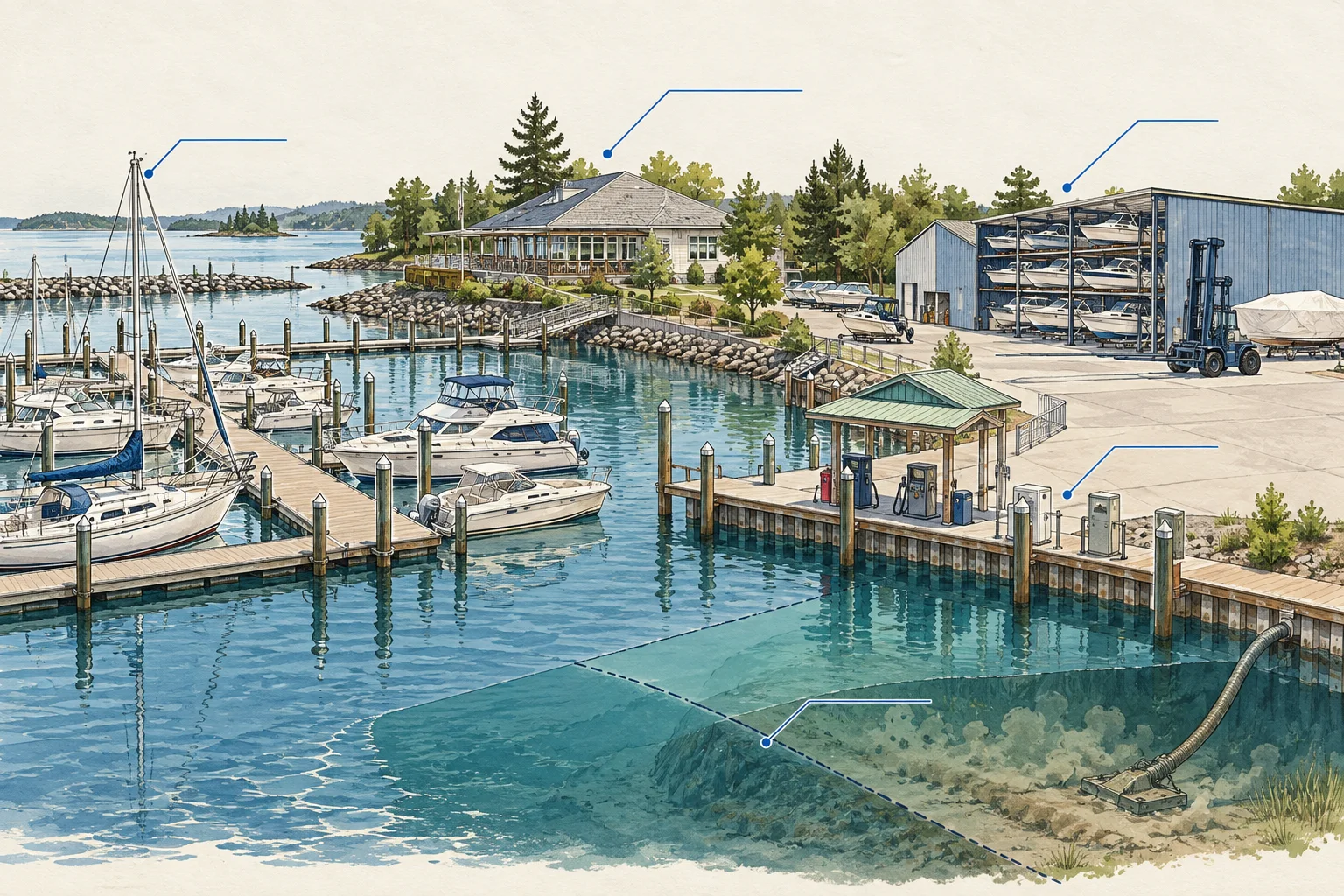
Conceptual illustration of marina berths, submerged-land rights, fuel and maintenance obligations

What changes the decision

Read the operating model before the headline

01

Fuel creates a separate review path

EPA’s marina spill-prevention guidance addresses petroleum storage and facility circumstances. Use it to identify whether fuel operations require a specialist review, not to declare a facility compliant from its size or appearance. Request the actual tank, storage and response records. Water access and berth economics do not answer fuel-system questions.

Source 1
02

The water interest may differ from the upland

Establish which interest controls docks, submerged land, access and shoreside facilities. Ownership of adjacent upland should not be assumed to include every operating right. Keep the agreement area, term, transfer conditions and maintenance responsibilities visible. A marina can have a coherent business while relying on several documents issued by different parties.

03

Depth and maintenance need dated evidence

Advertised depth, a historic sounding and a current navigational condition are different facts. Request dated measurements and records of maintenance work where relevant. Keep sediment management, dredging authorization and disposal arrangements distinct. An old dredging project does not establish present depth or an unrestricted right to repeat the work.

Keep these separate

Three distinctions to preserve in the file

Evidence or situationWhat it tells youWhat to establish next
Wet-slip contractDescribes a customer’s use of a berthMatch the berth to the marina’s underlying rights, dimensions and service commitments.
Dry-storage incomeDepends on land, handling and equipmentEstablish the storage boundary, equipment responsibilities and operating permissions.
Fuel or service receiptsAdds a distinct operating activityReview the relevant contracts, infrastructure and environmental obligations separately.
Conceptual illustration of marina berths, submerged-land rights, fuel and maintenance obligations

A practical review sequence

Build a file another reviewer can follow

Use the sequence below to turn the initial description into specific document requests. Preserve contradictory records instead of choosing the more favorable version.

  1. Inventory the operating components

    Assign IDs to wet berths, dry spaces and material service areas. Record which income categories depend on each component. Separate a customer berth agreement from the marina’s underlying tenure. AI can build the crosswalk, but any unresolved overlap or missing boundary should remain a specific question.

  2. Collect the rights and transfer record

    Request upland title information, submerged-land leases or authorizations, access arrangements and relevant amendments. Ask counsel to identify term, consent and transfer conditions. Keep a proposed renewal separate from the current document. Do not describe water rights as perpetual merely because the business has operated for many years.

  3. Review physical and environmental dependencies

    Obtain available bathymetric or depth information, dock inspections, electrical and fuel records, and maintenance authorizations. Record scope and date for each. Qualified reviewers should decide what further investigation is needed. A source search with no match is not proof of clean sediment, adequate depth or a safe fuel system.

  4. Prepare the continuity questions

    Link customer contracts, seasonal periods and planned work to the rights and facilities supporting them. Identify who funds dock replacement, channel maintenance and utility service. Export unresolved items for legal, marine-engineering and environmental review before assuming a new owner can continue every activity on the same terms.

Questions that arise during review

Resolve the ambiguity before the model

Does owning the shore mean owning the marina rights?

Not necessarily. Review the actual interests and agreements governing the water area, docks, access and upland. This worksheet organizes those documents; it does not determine title or imply that one parcel record establishes the whole operation.

Can historic dredging establish present capacity?

No. It is evidence of a past activity with a particular scope. Current depth, maintenance needs and authorizations require their own review. Keep measured observations and permissions separate so one is not used as a substitute for the other.

What can AI organize for a marina review?

Ask it to match berth IDs, seasonal customer contracts and the areas described in underlying water-use agreements. Flag unmapped berths and agreements ending before customer commitments. Have marine counsel verify rights and the manager confirm the inventory; AI should not infer depth or dredging permission from that crosswalk.

From the page to your next task

Start with the useful output.

Berth-to-tenure and maintenance register

Build an editable berth-to-tenure and maintenance register, retain document references and open decisions, then export your team's working file.

Scope: marina berths, submerged-land rights, fuel and maintenance obligations

Bring
An optional file nickname Status, observations and document references for the four evidence items; unknown is acceptable
Leave with
Berth-to-tenure and maintenance register with editable, expandable records and document locators Two fictional worked rows showing mismatches and decisions to review CSV and readable text exports with row provenance, method sources and edition A separate document-request companion with suggested reviewers

Edition 2026-09-30.1

Evidence and scope

Follow each claim to its source.

Commercial Real Estate Lending, Comptroller’s Handbook, version 2.0

Office of the Comptroller of the Currency · Checked 2026-09-30

March 2022 supervisory handbook; lease review, property income, re-leasing costs and property-type distinctions.

  • Bank supervisory guidance, not a property appraisal, current market survey or universal financing standard. No handbook percentage is adopted as a deal assumption.
Open original source ↗
SPCC Guide for Marinas and Boat Owners

U.S. Environmental Protection Agency · Checked 2026-09-30

Marina petroleum storage and spill planning context, with links to applicable requirements.

  • Fuel-system requirements depend on facility circumstances; this source does not verify submerged-land rights, depth, dredging permissions or environmental clearance.
Open original source ↗