

Park identity and property interests

Mobile home park review: match sites, homes and ownership

Start by reconciling the operating park, the parcels and interests being offered, and the dated site roster. Keep site occupancy, home ownership and income categories separate. Use the first review to identify contradictory records and missing documents, then assign the next requests before treating the file as ready for underwriting.

Private asset-page draft with a document-request prototype. Meadowlark is a published workflow example, not a market sample or a result produced by this planner. No territory research, property list or completed MHP valuation pack is included.

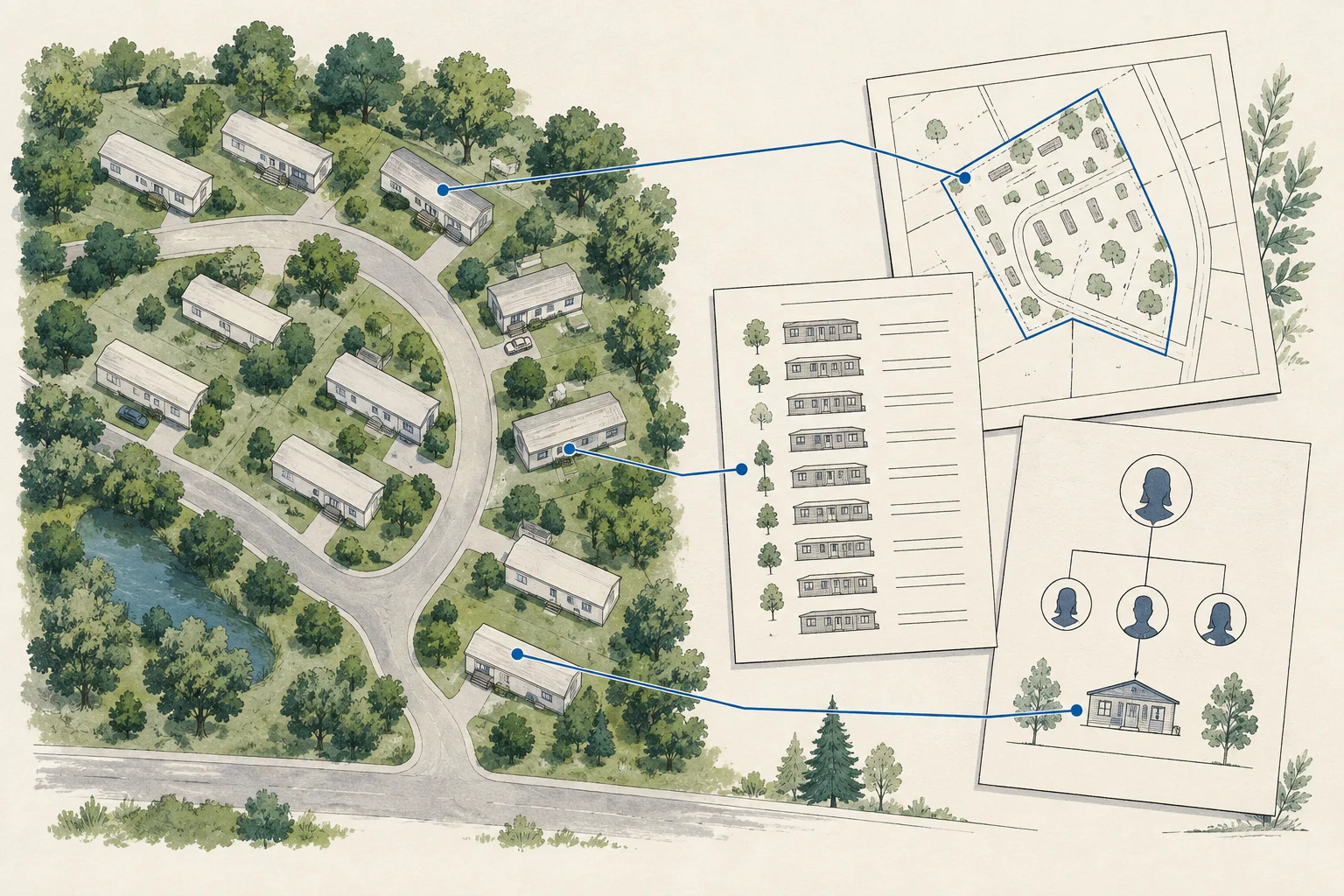
Conceptual diagram separating a manufactured-housing park, its sites, homes, parcels and ownership records.

Define the asset before the model

Give each record a separate job.

01

Keep sites and homes distinct.

Fannie Mae’s MHC program describes community sites, shared amenities and infrastructure, while separately addressing park-owned homes. Use that distinction when organizing site rent and home-related income. Its program requirements are not universal acquisition rules.

Source 1
02

Write the ownership chain instead of guessing it.

In the proposed review file, keep the recorded owner, operating entity and potential contact in separate fields. Attach the document and date that support each relationship. Leave competing identities unresolved until the appropriate evidence is available.

03

A document available is a document to review.

The planner asks whether you have the evidence. An available file becomes a review task; a missing file becomes a request; an unknown becomes a confirmation task. None of those answers verifies the underlying park or economics.

A practical file structure

Separate the evidence before you reconcile it.

Working recordWhat to captureQuestion to leave open
Offered footprintOperating boundary, parcel schedule and interests included in the proposed sale.Do the offered interests cover the same footprint described in the operating documents?
Site and home rosterA dated site identifier, occupancy field and separate home-ownership field.Which homes, if any, are included with the real estate, and which records support that distinction?Source 1
Operating and ownership recordsIssuing authority, entity identifiers, document date and the relationship each record supports.What still requires clarification by the authority or title/legal reviewer?
Income and responsibilitiesRent-roll categories, operating statements and utility or infrastructure obligations.Which income and expense assumptions can be tied back to the actual documents?
Conceptual record map linking a park footprint to separate parcel, site, home, operating and ownership evidence.

Use the request planner

Five questions produce a focused next-step brief.

This is a newly authored task method. It adapts the evidence distinctions to a short working tool; it does not reproduce a client file or promise a completed research product.

  1. 01 / Confirm the offered footprint

    Ask for the operating boundary and current parcel schedule. Record any missing parcel or interest for the title/survey reviewer rather than merging records on a similar name.

  2. 02 / Reconcile the site roster

    Request the dated roster and rent roll. Keep sites, occupancy and home ownership in separate columns, then list unmatched or conflicting entries.

  3. 03 / Identify the operating record

    Ask which current licenses, permits or other authority records apply locally. Record the issuing authority and date, and refer unresolved permission questions for review.

  4. 04 / Trace ownership evidence

    Follow the recorded ownership reference and relevant entity filings. Preserve uncertain links. A named entity or contact is not an instruction to contact anyone.

  5. 05 / Request the economic inputs

    Collect operating statements, current rent roll and utility responsibility documents. Tie the intended model inputs to those records and keep unsupported assumptions visible.

Relevant published experience

A sourcing-to-review workflow in manufactured housing.

Published reference · NextAutomation

Meadowlark: Manufactured Housing Sourcing & BOV

The published Meadowlark story connects park discovery, research prioritization and ownership evidence to a broker-reviewed valuation workflow. It provides a concrete example of connected research and review, not a finding about a park entered into this planner.

Upper Midwest; state footprint described in linked system study. Asset context: manufactured housing, mobile home parks.

  • Research categories are not conversions, transactions or willing sellers.
  • Dataset property locations are not enumerated by this public snapshot.
  • This is a first-party implementation account, not independent verification of investment outcomes.
  • Public narrative evidence, not independent validation of a new property or market.
Read the published reference ↗

Before you use the tool

What will the first review establish?

Does a site roster tell me which homes I would own?

Keep those questions separate. A site schedule and a home-ownership schedule serve different purposes. Fannie Mae’s MHC materials also distinguish community sites from park-owned homes; obtain the actual transaction documents before resolving the interest being acquired.

Source 1
What if I do not have the documents yet?

Use Unknown when availability has not been established and Missing when the file is absent. The planner turns those choices into confirmation or request tasks and names the relevant provider or reviewer.

Does this find owners or produce a valuation?

No. This version organizes your next evidence requests. It retrieves no records and verifies no ownership, site count, operating permission, income or value. It does not send messages or requests.

Is this the same as the full MHP research report?

No additional report is required for this edition. The published Meadowlark case provides a bounded example of connected sourcing and human review. The current identity planner is an authored workflow prototype; it does not supply a researched park inventory or independently verified property matches.

Source 1

From the page to your next task

Start with the useful output.

Manufactured-housing identity and request planner

Separate missing documents from documents awaiting review, then leave with a focused request brief and a responsible reviewer for each task.

Scope: A five-question working prototype for organizing park, site, operating, ownership and economics evidence. No territory dataset or real park analysis is included.

Bring
An optional label for the park under review. Document availability for the offered footprint, site roster, operating records, ownership chain and economics.
Leave with
A task list grouped into confirm, request and review. A copyable brief naming the evidence sought, why it matters and who should review it.

Edition 2026-09-29.1

Evidence and scope

Follow each claim to its source.

Meadowlark: Manufactured Housing Sourcing & BOV

NextAutomation · Checked 2026-09-29

Upper Midwest; state footprint described in linked system study. Asset context: manufactured housing, mobile home parks.

  • Research categories are not conversions, transactions or willing sellers.
  • Dataset property locations are not enumerated by this public snapshot.
  • This is a first-party implementation account, not independent verification of investment outcomes.
  • Published first-party narrative; private delivery inputs were not independently re-audited in this review.
  • This published page must not be counted as a separate client simply because it has a separate URL.
Open original source ↗
Manufactured Housing Communities Term Sheet

Fannie Mae · Checked 2026-09-29

Program description distinguishes community sites, shared infrastructure and park-owned homes. Used only for that operating-unit distinction.

  • Program-specific financing guidance, not a universal acquisition rule or a determination of eligibility.
  • No property documents, current rents, licensed capacity or ownership interests were verified.
Open original source ↗