

Multifamily Renovation Tracking: Budget, Rent and Collections
Track multifamily renovations from approved scope and cost to signed rent and collections. Keep incomplete units visible with a fictional unit-level worksheet.
Multifamily Renovation Tracking: Budget, Rent and Collections
Track multifamily renovation results by joining each unit's approved scope, changes, cost, completion, lease terms and period-specific collections. Keep projected rent, signed rent and collected cash separate. Compare completed units over stated observation windows, retain unfinished and vacant units, and do not attribute a rent change entirely to renovation without supporting evidence.
The multifamily underwriting walkthrough separates operating history from acquisition assumptions. This guide follows one assumption after acquisition: whether a unit renovation produced the result used in the business plan. The worksheet is a reconciliation exercise, not a rent-setting model or an investment return forecast.
Give each unit a cost record and an operating record
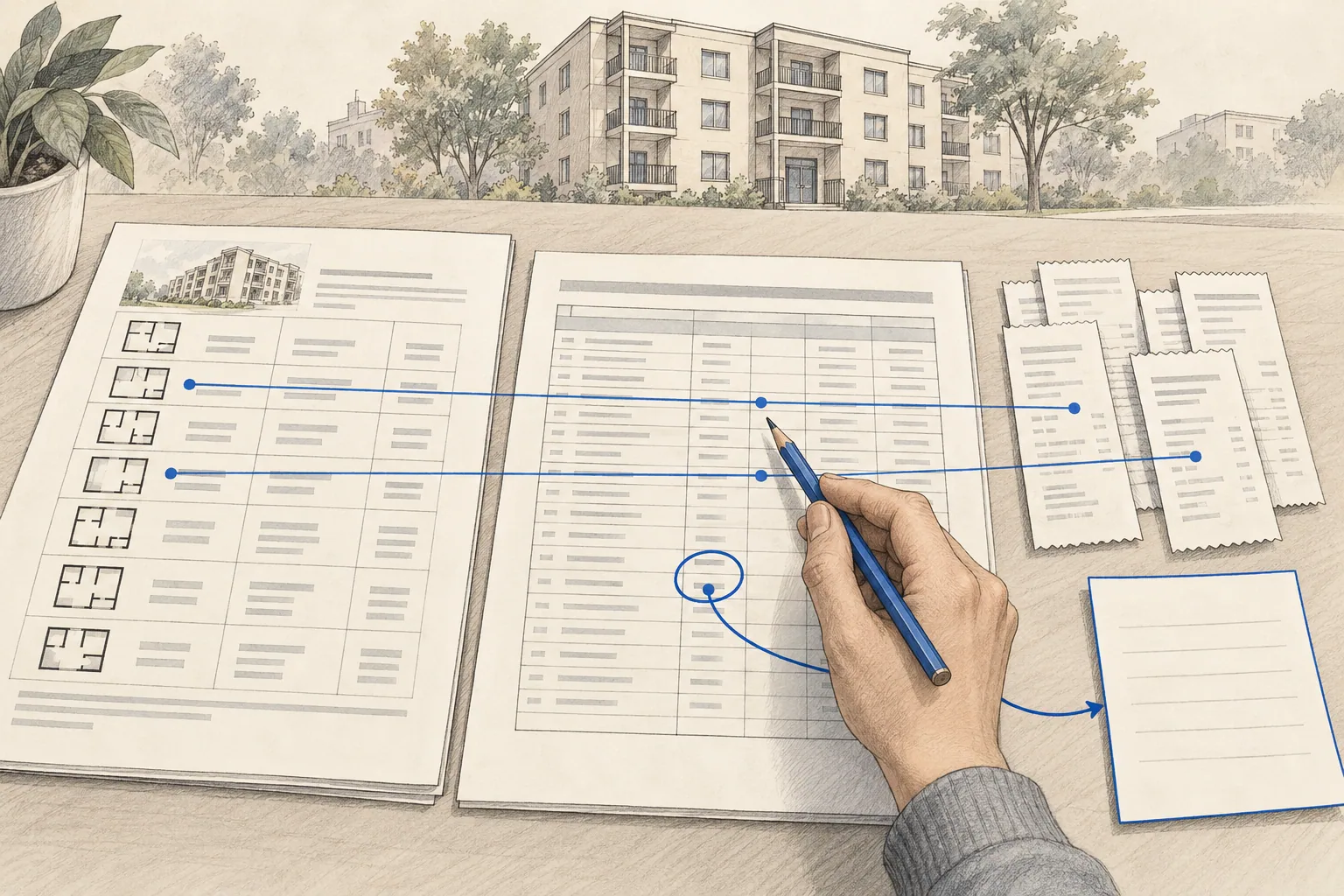
Use a stable unit identifier across scope, invoices, completion evidence, lease records and the collections ledger. Keep the original budget, approved changes, paid invoices, approved unpaid invoices and remaining commitments in separate fields. Paid cash alone does not show the full expected cost.
Record completion and ready-for-occupancy dates separately from lease start and collections. The Fannie Mae multifamily fraud-prevention guidance identifies reported improvements that lack onsite support or supporting documents as a review concern. Apply that principle by retaining completion evidence with the unit, rather than treating a payment or a reported status as proof of completed work.
For rent, preserve the prior contract, the target assumption, the new signed contract, concessions and cash allocated to the observation period. Do not replace an underperformed target with the actual result and lose the original business-plan assumption. A variance needs both.
Fannie Mae's August 2024 Form 4254 definitions distinguish vacancy, concessions, bad debt and capital expenditure fields. This worksheet uses its own narrower teaching definitions. It does not reproduce Fannie Mae's reporting form, establish lender compliance or determine accounting classifications.
Reconcile the fictional renovation budget
The renovation tracking practice pack contains four fictional units, an approved cost ledger, a rental observation table, a blank register and a calculation checker. All amounts, dates, units and supporting document descriptions are invented. The as-of date is September 30, 2026.
| Fictional unit | Original budget | Approved changes | Revised budget | Paid | Approved unpaid invoices | Remaining committed work |
|---|---|---|---|---|---|---|
| U-101 | $10,000 | $1,000 | $11,000 | $10,500 | $500 | $0 |
| U-102 | $11,000 | $2,000 | $13,000 | $12,800 | $200 | $0 |
| U-103 | $10,000 | $0 | $10,000 | $6,000 | $0 | $4,000 |
| U-104 | $9,000 | $0 | $9,000 | $9,000 | $0 | $0 |
| Total | $40,000 | $3,000 | $43,000 | $38,300 | $700 | $4,000 |
The example's expected cost is $43,000: paid cash of $38,300 plus approved unpaid invoices of $700 plus remaining committed work of $4,000. Those categories are mutually exclusive in the fixture. In a real ledger, reconcile commitment balances against invoiced amounts before summing them, and label estimates separately from contracted commitments.
U-103 is still in progress. Its low paid amount is not a completed-project saving. U-104 is physically complete but remains vacant at the as-of date. It cannot contribute a measured post-renovation rent result. Both remain in the program cost total and in the operating exception view.
Keep signed rent and collected cash in separate columns
U-101 and U-102 were completed before July 1 and have signed leases covering the full July-through-September observation window. The exercise contains no starting receivable, prepaid rent, deposits, other income or collections allocated to a different period. That makes the following arithmetic deliberately narrow.
| Fictional observation | U-101 | U-102 |
|---|---|---|
| Prior monthly contract rent | $1,200 | $1,250 |
| Target monthly contract rent | $1,450 | $1,500 |
| New monthly contract rent | $1,400 | $1,500 |
| Three months of base rent charges | $4,200 | $4,500 |
| Concessions allocated to those months | $600 | $0 |
| Net charges for the period | $3,600 | $4,500 |
| Cash collected and allocated to the period | $3,500 | $4,500 |
| Uncollected amount still outstanding | $100 | $0 |
The combined new monthly contract rent exceeds the combined prior contracts by $450. Multiplying that difference by twelve produces a $5,400 annualized contract-rent difference. It is not incremental NOI, cash collected or a renovation yield.
For the observed quarter, the prior contract amounts multiplied by three total $7,350. Actual allocated collections total $8,000, a $650 difference from that simple baseline. The baseline is a comparison convention, not proof of the cash that would have been collected without renovation. It assumes the prior contract amounts over the same period and does not model vacancy or changes in tenant behavior.
Do not subtract the $600 concession or the $100 outstanding amount from the $8,000 collected cash again. The exercise already reconciles charges, concessions and receipts. The outstanding amount is not labeled bad debt because the fixture does not establish that it is uncollectible.
Keep unfinished outcomes in the review
Report the full cost population beside the observed rent population. Here, all four units contribute costs, but only two have a complete, comparable post-renovation observation window. U-103 needs completion evidence; U-104 needs a lease and subsequent collections before a realized result can be measured.
The practice register also keeps work-related offline days separate from vacancy after the unit is ready. Neither is automatically an incremental renovation loss. A before-and-after return calculation needs an explicit counterfactual and the other relevant expenses, timing and operating effects.
To evaluate causation, examine comparable units, lease timing, unit mix, market changes, scope differences and tenant changes. A small completed-unit sample selected for attractive outcomes cannot establish the result for the entire program. Keep those limits visible when the asset manager updates the acquisition case.
Test the handoff into the operating review
Reconcile invoices to commitments, unit IDs to the lease register and period allocations to the collections ledger. Test a duplicate invoice, a concession already netted from receipts, a missing completion date and a payment allocated to an earlier month. Each should produce a review item rather than a more confident summary.
AI can organize the documents and propose matches. The reviewer should inspect material completed rows as well as exceptions. Carry the accepted inputs and open questions into the underwriting model-builder resource, preserving both the original plan and the observed result.
Frequently asked questions
Is the signed rent increase the realized renovation return?
No. Signed rent, concessions, period collections, costs and timing measure different things. A contract-rent increase alone is neither incremental NOI nor a causal return from the renovation.
Should unfinished or vacant renovated units be excluded?
Keep them in the full cost and status population. Exclude them only from a clearly defined comparable observation calculation when the necessary data is missing, and show that exclusion and its reason.
How should concessions be handled when measuring collected rent?
Reconcile charges less concessions to receipts and outstanding amounts for the same period. Do not subtract a concession again from a cash figure that already reflects its effect.
Can a before-and-after rent comparison prove the renovation caused the increase?
No. Lease timing, market conditions, unit mix, tenant changes and selection can affect the result. The fictional prior-contract baseline is a comparison convention and does not establish a counterfactual.
Related Articles
CRE Insurance Quote Comparison: Check the Coverage and Cost
Compare CRE insurance quotes by coverage, limits, deductibles and total cost before changing the underwriting case. Includes a fictional quote worksheet.
Commercial Lease Rollover Schedule: A Checked Example
Build a commercial lease rollover schedule with an as-of date, checked area and rent totals, and options kept separate. Includes a fictional CSV exercise.
CRE Refinance Cash-In Gap: Reconcile the Cash Needed at Closing
Calculate a CRE refinance cash-in gap from loan proceeds, payoff, fees and reserves. Reconcile prior payments with a fictional sources-and-uses worksheet.