

CRE Insurance Quote Comparison: Check the Coverage and Cost
Compare CRE insurance quotes by coverage, limits, deductibles and total cost before changing the underwriting case. Includes a fictional quote worksheet.

CRE Insurance Quote Comparison: Check the Coverage and Cost
Compare commercial real estate insurance quotes by matching the property, policy period, valuation basis, covered events, limits, deductibles and income protection before comparing cost. Keep unresolved differences visible. Then show how each quoted expense changes the underwriting scenario without implying that a cheaper quote provides equivalent protection or has been bound.
This guide provides a document comparison and a fictional calculation exercise. It does not select an insurer or interpret a policy. Use the actual quote, forms and endorsements with the responsible insurance adviser before accepting coverage assumptions.
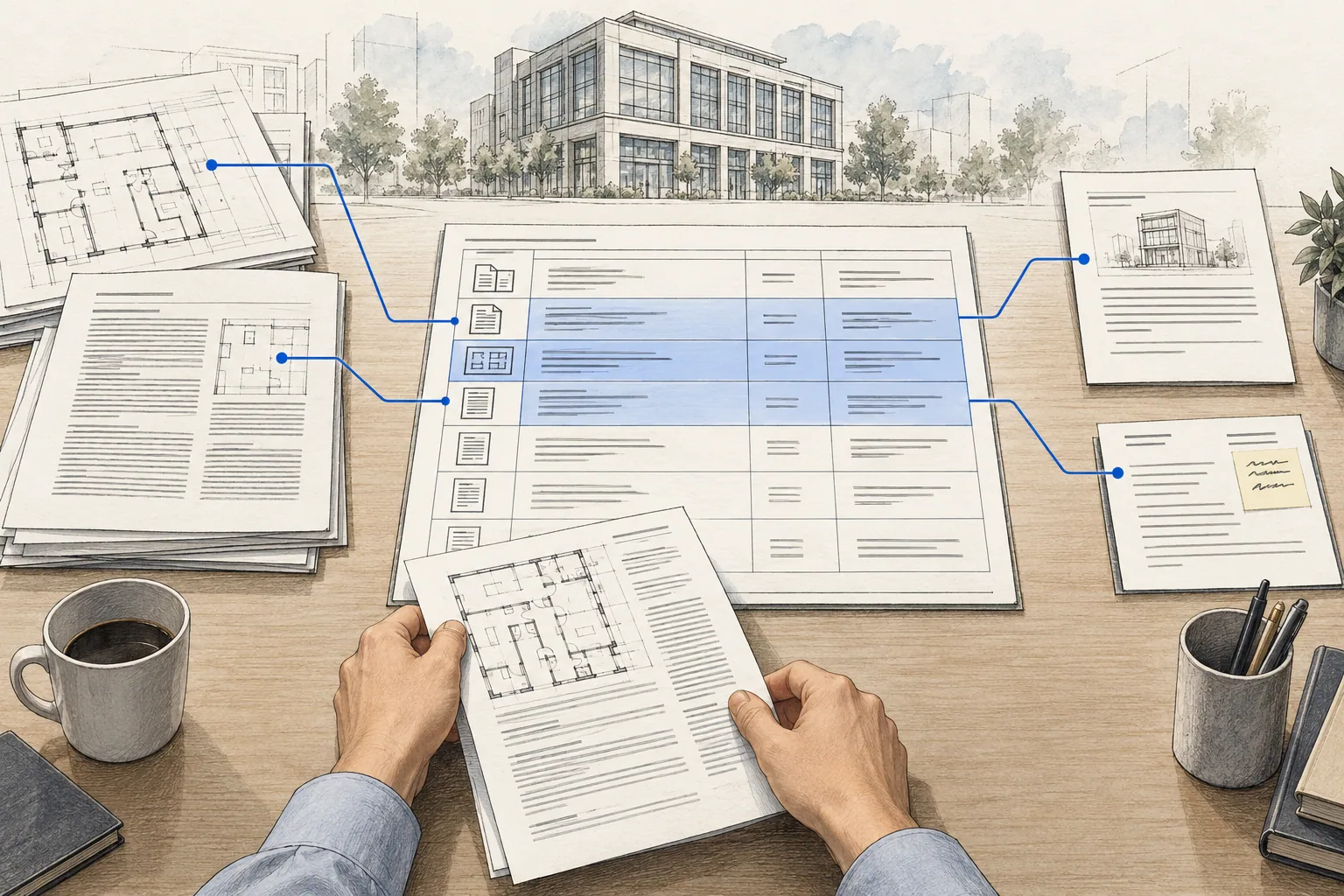
Start with a common comparison record
Record the insured entity, location schedule, intended use, covered period, quote date, expiry and outstanding conditions. A quote for a different building schedule or an incomplete submission should remain a separate case. Preserve the document version so a later revision does not silently replace the basis for the comparison.
The NAIC's small-business insurance guidance distinguishes actual cash value from replacement cost and explains that property coverage forms differ. It also advises reviewing individual policy terms. Those distinctions are a reason to capture the basis and forms beside the premium. The guidance is general background; it does not establish coverage for a specific CRE asset.
Build a comparison with fields the reviewer can trace:
| Review area | Record | Question to resolve |
|---|---|---|
| Property and period | Named insured, locations, use, term | Are the quotations for the same risk and dates? |
| Valuation and limits | Basis, scheduled values, limits and sublimits | Which values and limits apply to which location or event? |
| Deductibles | Amount or percentage, stated basis, minimums | What does the percentage apply to under these forms? |
| Income protection | Form, limit, waiting period, period of indemnity | What income and interruption conditions does the proposed coverage address? |
| Conditions | Exclusions, endorsements, outstanding information | Which differences remain unresolved by the adviser? |
| Cost and timing | Premium, taxes, fees, financing charges, payment dates | Which amounts belong in the operating case and cash schedule? |
Do not fill an omitted clause with a market convention. “Not stated in the supplied documents” is a useful review status. Keep the missing form or question attached to the quote.
Reproduce the fictional cost comparison
The insurance quote comparison practice pack contains invented quote summaries, a blank register, reviewer questions, scenario outputs and a calculation checker. No actual carrier, offer, coverage analysis or rate benchmark is represented.
Both fictional quotes cover the same invented building and a twelve-month period. They use a scheduled building value of $7,500,000. The exercise explicitly states how each wind deductible is calculated; that assumption must not be carried into an actual policy without checking its wording.
| Fictional input | Quote A | Quote B |
|---|---|---|
| Annual premium | $48,000 | $42,000 |
| Included taxes and fees | $1,200 | $2,000 |
| Total quoted annual cost | $49,200 | $44,000 |
| Wind deductible in the fixture | $50,000 flat | 2% of the $7,500,000 scheduled building value |
| Calculated wind deductible | $50,000 | $150,000 |
| Premium financing charges | $0 assumed | $0 assumed |
Quote B has a $5,200 lower quoted annual cost in this exercise. Its stated wind deductible is $100,000 higher. These differences cannot be collapsed into a finding that B is better. The exercise supplies neither an event probability nor a complete claim settlement calculation, and the coverage comparison still contains open questions.
The deductible is not added to the annual premium as though a loss necessarily occurs every year. Show that exposure separately. If the team models a loss scenario, label its event, coverage assumptions and owner cash requirement explicitly. A quoted deductible alone does not establish the final amount a policyholder would pay or receive after a real claim.
Carry the expense into a named underwriting case
Suppose the fictional property's annual income less operating expenses other than insurance is $720,000. For this limited exercise, the entire quoted premium, taxes and fees are treated as an annual operating expense. No reimbursement, financing charge, reserve, casualty loss or tax effect is modeled.
Quote A produces $670,800 of illustrative NOI: $720,000 minus $49,200. Quote B produces $676,000: $720,000 minus $44,000. With fictional annual debt service fixed at $500,000, the corresponding NOI-to-debt-service ratios are 1.3416 and 1.3520. These are arithmetic scenarios, not lender approval or a recommendation to bind either quote.
Keep the historical insurance expense intact and record the proposed replacement amount, source, period and acceptance status in the T-12 adjustment register. A provisional quote can inform a scenario while remaining excluded from the team's accepted acquisition case.
Payment timing also needs its own view. An annual expense assumption does not tell the team when cash leaves the account. Reconcile the actual billing or finance schedule separately, and avoid counting the same premium again through both the annual expense and installment principal.
Review changes before refreshing the memo
Have the reviewer resolve differences in forms, deductibles, limits and conditions with the insurance adviser. Record the answer and the supporting document. If a required answer remains unavailable, keep that item open and identify its consequence for the model or closing process.
AI can help organize quote fields and identify passages for review. Check apparently complete fields as well as flagged exceptions. In the practice pack, changing Quote B's percentage basis changes the deductible calculation; it must not change the premium or silently overwrite the source wording. A missing basis should stop that calculation and remain visible.
Keep a dated comparison with the underwriting model-builder resource. The accepted handoff should identify the selected scenario, the responsible reviewer, unresolved conditions and the document that supports the expense. An updated memo should explain which assumption changed.
Frequently asked questions
Can I compare commercial property insurance by premium alone?
Premium is only one field. Match the property and term, inspect valuation basis, limits, deductibles and forms, and keep unresolved coverage differences visible before deciding what the comparison supports.
How do I calculate a percentage wind deductible?
Use the percentage and its exact basis in the actual policy. In the fictional exercise only, 2% of a stated $7,500,000 scheduled building value is $150,000. Other bases or policy conditions require a different review.
Should a deductible be added to the annual insurance expense?
The exercise keeps the deductible separate from annual premium, taxes and fees. It is not an assumed annual loss. A loss scenario needs explicit event and coverage assumptions and is not supplied here.
Does an underwriting scenario mean the insurance is bound?
No. A provisional expense can be modeled without coverage being accepted or bound. Keep the quote, conditions, reviewer decision and actual provider confirmation separate.
Related Articles
Commercial Lease Rollover Schedule: A Checked Example
Build a commercial lease rollover schedule with an as-of date, checked area and rent totals, and options kept separate. Includes a fictional CSV exercise.
CRE Refinance Cash-In Gap: Reconcile the Cash Needed at Closing
Calculate a CRE refinance cash-in gap from loan proceeds, payoff, fees and reserves. Reconcile prior payments with a fictional sources-and-uses worksheet.
Industrial Lease Renewal vs. Re-Letting: Compare the Cash Flow
Compare industrial lease renewal and re-letting over the same period. Model downtime, free rent, tenant work and commissions with a fictional monthly worksheet.