CRE acquisitions
The AI Acquisition Infrastructure
One lead agent and five specialists that carry a parcel from the entity on the deed to a buy-box verdict, a first-pass underwrite, an IC memo and the letter. It names the owner where you supply the registry filings, and hands you the exact plan to name one where you do not.
The same pipeline we build for acquisition teams, written out so you can install it yourself.
See open timesFive stages, one system
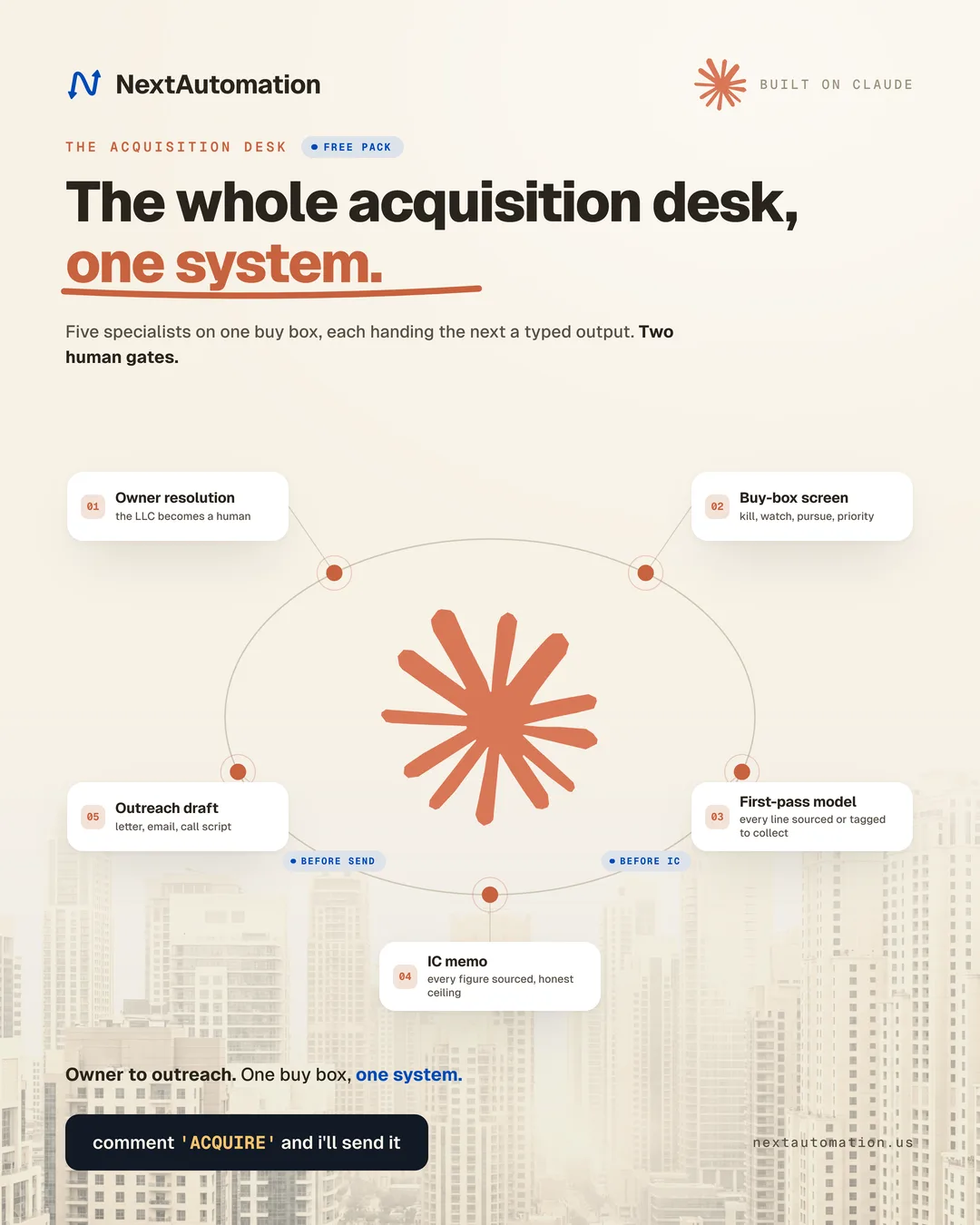
Most acquisition stacks are five disconnected tools and an analyst copying between them. This is the same work as one pipeline.
- 01
Resolve the owner
The parcel arrives as an entity on a deed. Supply the registry filings and it works the chain until two records agree on one person. Supply the CSV alone and it says so plainly: zero humans resolved, and here is the registry, the filing and the field pair that would name each one.
- 02
Screen against the buy box
Every parcel gets a verdict: KILL, WATCH, PURSUE or PRIORITY, with a fit score and the reason written on the row. Nothing leaves the pipeline without a counted reason.
- 03
Underwrite the first pass
A first-pass model shell where every line is either sourced or tagged as an input to collect, never guessed. It also ranks the documents you could hand it by how much each one would fill.
- 04
Write the IC memo
Eight sections where every fact carries the record it came from or its collect tag, plus a sources block, an open-items list, and an honest-ceiling section that states what the memo does not cover.
- 05
Draft the outreach
A letter, an email and a call script that could only be about that parcel, built from what the pipeline established and nothing else. No dollar figure in a first touch.
One lead agent runs all five and owns the handoffs, so the screen, the underwrite and the memo read the same buy box and the same row. Two gates stay human on purpose: one before the memo goes to IC, one before anything leaves your mailbox.
What is inside
One lead agent, five specialists, and everything they read.
Install guide
File tree plus install paths for a Claude Project, Claude Code, ChatGPT and Codex. Ten minutes from download to a running pipeline.
Implementation guide
The architecture end to end: what each stage reads, what it writes, and where the two human gates sit.
The buy box
One JSON file: asset type, size, market, thesis, distress signals. Written once, read by every agent downstream.
Stage contracts
Input and output columns per stage, plus the exclusion count each stage owes you. This is what keeps rows from vanishing between steps.
A fifty-row sample and a memo
A real public-county run at the property level, one IC memo generated from the top row, and the provenance note naming the portal and the pull date.
Outreach templates
Owner letter, email and call script, with the property-specific slots the pipeline fills.
The two human gates
What a person checks before the memo goes to IC, and before anything is sent. Twenty minutes that keep a wrong-owner letter from going out with your name on it.
The lead agent and five specialists
Owner resolver, deal screener, underwriter, memo writer, outreach writer, and the acquisition lead that dispatches them. Paste-and-run, each one.
Worked example
The whole pipeline on the sample county, with the counts at every stage. The number nobody publishes is how many rows survive each filter.
The sample run
Fifty rows you can run today
The pack ships with a real run so you can watch the pipeline work before you have your own data. Here is exactly what those rows are, and what they are not.
What the rows are
- One public county: Mecklenburg County, North Carolina.
- Property level: parcel id, street name, asset type, size, year built, assessed value, last sale year.
- The owner entity exactly as recorded on the deed, plus distress signals, buy-box fit and rank.
- Every row badged SAMPLE, so no row can be mistaken for live deal flow.
What the rows are not
- No owner contact data of any kind.
- No resolved human names. The entity string on the deed is where the free sample stops.
- No phone numbers, no email addresses, no mailing addresses.
- Not a client run. Public county records only, never rows from work we did for someone else.
Owner contacts are not in this download. What ships is the method and the public property-level trail. Resolving an entity to a reachable human is a separate engagement with its own verification work, which is why a free zip does not hand you the people.
Want it built and run on your pipeline?
We build it on your data, in your markets, and hand back the working system.
Book a 20-min callGet the pack
Free, and it installs in the tool you already use. It is a first-pass system, not straight-through processing, and the IC call stays human.
Download the pack
Want the system, not just the files?
Get the full pack once, then use the walkthrough below to see exactly what is inside and how to run it.
Get The AI Acquisition Infrastructure Pack
Enter your details and the full pack downloads right away. No cost.
Have us build it for you
Twenty minutes. Bring your buy box and we will walk the pipeline on your own markets.
Questions real estate teams ask
What is the AI Acquisition Infrastructure?
How do I install and run it?
What does this pack not do?
Does the pack include owner contact data?
What is in the fifty-row sample?
Which markets does it work in?
How is this different from the Off-Market Sourcing System?
Where AI changes the answer
The bottleneck in acquisitions was never the analysis, it was the handoffs. A stage contract between agents means the screen, the underwrite and the memo read the same buy box and the same row, so nothing gets retyped and nothing gets silently dropped.
Related resources
Want the system, not just the files?
Two ways to go further with NextAutomation.
Work with us
Have us build the sourcing-to-reporting pipeline these files only hint at. Custom AI systems for your firm.
Apply to work with usJoin the community
Live builds, the template library, and a room of operators using AI on real deals. from $49/mo.
Join the communityFrom free pack to full system
AI Deal Sourcing for Off-Market Pipeline
How the front of this pipeline runs in production: finding owners, scoring motivation, and routing targets before deals reach the open market.
The AI Underwriting Copilot
Want the underwriting and memo half run on your own pipeline? We build it on your documents and your underwriting standards.